Mar 06, 2026
Yes, if: You operate a warehouse, manufacturing facility, or distribution center requiring a reliable 2-ton capacity forklift for daily material handling. The RF20 combines a fuel-efficient diesel engine with RIPPA’s advanced hydraulic system to deliver up to 20% fuel savings compared to conventional models, significantly reducing your total operating costs .
Consider if: You need Euro 5 emission compliance (the RF20 meets latest regulations), prioritize operator comfort with its dual floating structure and full suspension seat, or value the durability of Komatsu-derived axle technology .
No, if: You require indoor-only operation (diesel emissions require ventilation), need higher than 2-ton capacity (consider RF25 or RF35), or operate in extreme cold without proper winterization .
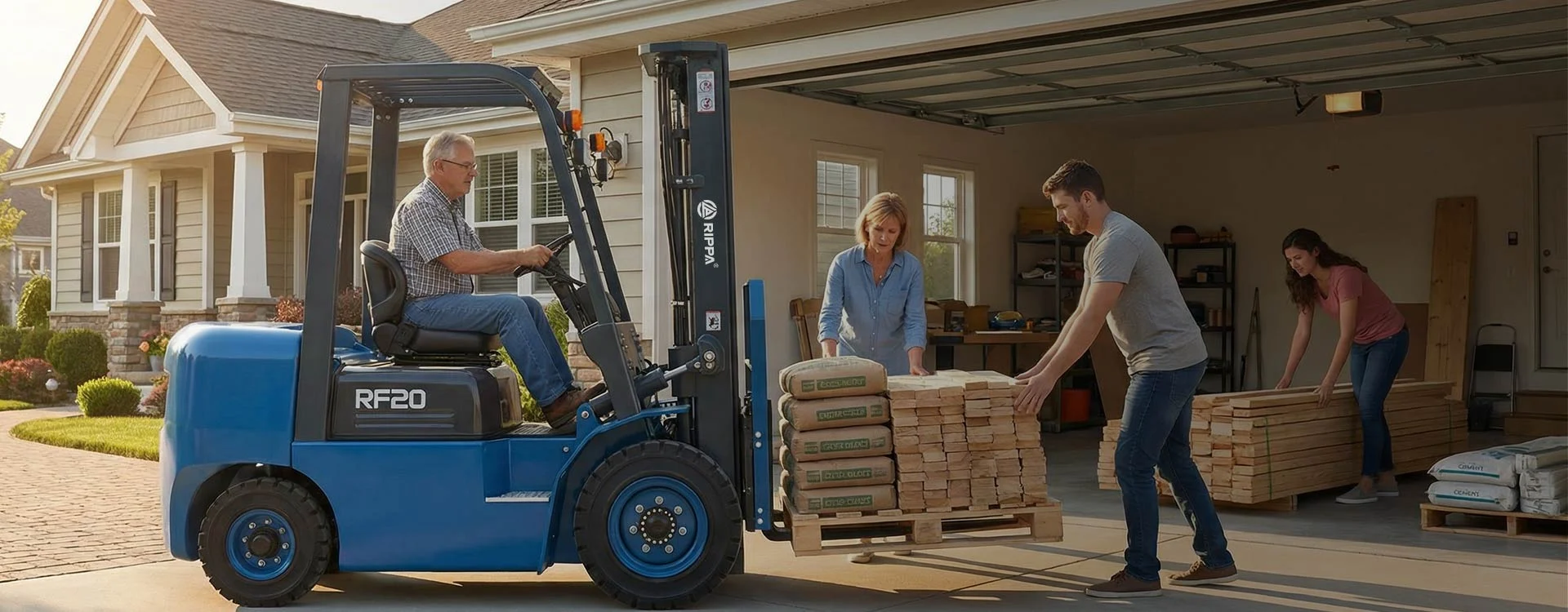
The RIPPA RF20 is a 2.0-ton (4,409 lb) capacity diesel forklift designed for general warehousing, light industrial, and commercial applications. It represents RIPPA’s entry point into the counterbalance forklift market, combining proven Japanese engine technology with RIPPA’s proprietary hydraulic innovations.
Key differentiating fact: The RF20 achieves its industry-leading 20% fuel reduction through a variable displacement pump system that automatically detects hydraulic load and supplies only the oil volume needed—eliminating wasteful constant-flow losses common in older designs .
| Specification | RF20 Value |
|---|---|
| Rated Load | 2,000 kg (4,409 lb) |
| Load Center | 500 mm (19.7 in) |
| Maximum Lifting Height | 3,000 mm (118 in) |
| Free Lifting Height | 100 mm (3.9 in) |
| Full Length (without forks) | 2,282 mm (89.8 in) |
| Full Width | 1,180 mm (46.5 in) |
| Wheelbase | 1,600 mm (63 in) |
| Minimum Ground Clearance | 125 mm (4.9 in) |
| Track Width (Front/Rear) | 972/970 mm (38.3/38.2 in) |
| Gantry Tilt Angle (Front/Back) | 6° / 12° |
| Fork Length | 1,070 mm (42.1 in) |
| Maximum Climbing Capacity (Full Load) | 15% |
| Maximum Climbing Capacity (No Load) | 20% |
| Total Weight | 3,400 kg (7,496 lb) |
| Tires | Pneumatic (Front 7.00-12, Rear 6.00-9) |
| Brakes | Hydraulic (Service), Mechanical (Parking) |
Engine Options:
| Engine | Power | Emission Standard |
|---|---|---|
| Changchai 390 | 18.4 kW (24.7 hp) | Euro 5 |
| Changchai 390 | 22.1 kW (29.6 hp) | Euro 3 |
Data source: RIPPA RF20 product manual specifications.
The RF20’s core innovation is its load-sensing hydraulic system coupled with a variable displacement pump. Unlike conventional systems that pump oil continuously regardless of demand, this system:
Automatically detects hydraulic load requirements
Supplies only the oil volume needed for the task
Eliminates hydraulic oil losses that waste energy
Reduces engine load during partial-demand operations
Result: Up to 20% reduction in fuel consumption compared to conventional forklifts of similar capacity .
The RF20’s Changchai 390 engine incorporates multiple technologies to optimize combustion:
| Technology | Function | Benefit |
|---|---|---|
| High Pressure Common Rail System | Precisely controls fuel injection timing | Complete combustion, lower emissions |
| Electronic Control System | Optimizes fuel-air mixture | Improved fuel efficiency |
| New Combustion System | Enhances flame propagation | Reduced particulate matter |
| Air-to-Air Charge Air Cooling | Cools intake air for denser charge | Higher power output, lower emissions |
Environmental impact: The Euro 5 configuration reduces CO2 emissions by approximately 7.2 tons per year compared to older models .
The RF20 uses NOK oil seals imported from Japan—the same supplier used by first-tier Japanese manufacturers—ensuring leak-free operation and extended hydraulic component life .
The CLSS (Closed-center Load Sensing System) enables a critical productivity feature: the ability to lift loads for fine height adjustment without increasing engine speed .
Applications where this matters:
Fine adjustment of fork height during precise positioning
Lifting fork tips before starting to move
Fine adjustment for side shifting operations
Operational benefits:
Smooth traveling during hydraulic operation
Superior productivity when fitted with attachments
Fuel consumption reduced by up to 20%
The RF20 achieves first-class cycle times comparable to RIPPA’s previous R-Series, with the diesel model delivering:
Speed increase (full load/no load): 350/500 mm/s
Maximum traction (full load/no load): 17 kN
The FHPS system provides:
Fully stationary steering capability—essential for maneuvering in tight spaces
Switchback operations using the small-diameter steering wheel
Superior response capability for easy maneuvering even with a load in confined areas
The RF20 is built for longevity with multiple structural reinforcements:
| Component | Design Feature | Benefit |
|---|---|---|
| Mast | Heavy rail profile | Excellent rigidity under load |
| Frame | Increased thickness at counterweight mounting | Greater durability for heavy use |
| Front Axle | Field-proven Komatsu wheel loader design | Reliability in demanding applications |
| Rear Axle | Improved power steering cylinder durability | Extended service life |
O-ring face seals on main hydraulic pipe connectors reduce leak potential
Waterproof connectors on main harnesses and system controller provide higher resistance to water and dust
Separate hydraulic and electrical piping configurations improve reliability and ease of service
The electronic engine controls include multiple fail-safe functions :
| Function | Operation |
|---|---|
| Trouble diagnosis | Engine malfunctions automatically detected, alarm lamp blinks |
| Overheating prevention | Engine output and RPM reduced when coolant temperature is high |
| Automatic engine warm-up | RPMs accelerated to warm engine at low temperatures |
| Automatic air pre-heating | Engine automatically pre-heated when starting at low temperatures |
The RF20’s hydraulic brake system offers multiple advantages:
Strong braking force with fast, smooth engagement
Cushioning valve enables braking force proportional to pedal pressure
Liquid conduction provides stable braking unaffected by environmental factors
Component connection design simplifies maintenance and part replacement
| Safety Feature | Function |
|---|---|
| Parking Brake Alarm | Alerts if operator fails to engage parking brake |
| Neutral Safety Function | Engine cannot start unless F-R switch is in neutral position |
| Brake Pedal Safety | Engine cannot start unless brake pedal is depressed |
| Neutral Indicator | At-a-glance confirmation of transmission status |
| ANSI/TSDF B56.1 Compliant | Meets industry safety standards for overhead guard |
Smaller steering wheel (11.8″ diameter) improves forward visibility to fork tips
Optional wide-angle center mirror enables easy rearward view
Redesigned dashboard enhances sightlines to critical areas
RIPPA’s unique dual vibration cushioning system reduces vibrations transmitted to:
Operator compartment
Steering wheel
Control levers
Mast
Vibrations from the engine or road surface are quickly absorbed, reducing operator fatigue and protecting the load .
The deluxe full suspension seat features:
Improved vibration resistance
Reduced stress on operator’s body during long shifts
Adjustable positioning for operator comfort
Low-noise design: Engine and fully sealed floorboard area reduce operational noise
Exhaust gas purification device: Reduces harmful emissions, protects environment
Air outlet positioning: Two counterweight air outlets on left and right, exhaust pipe at lower position—operators are not exposed to hot air or exhaust gases when driving in reverse
Finger-tip operation with electric F/R lever
Control levers with contoured knobs for ease of control
Minimum movement required for secure operation
Smooth entry and exit design
The RF20 incorporates multiple service-friendly features:
Component connection method simplifies maintenance and part replacement
Hydraulic and electrical systems separately configured for easier access
Brake system requires only regular fluid replacement and hose inspection—no other operating costs
| Component | Frequency | Notes |
|---|---|---|
| Brake fluid | Regular replacement | Per manufacturer specification |
| Brake hoses | Regular inspection | Check for wear/damage |
| Engine oil/filters | Per engine manual | Follow Changchai recommendations |
| Hydraulic system | Periodic check | Monitor for leaks, performance |
The RF20’s combination of:
20% fuel savings
Minimal brake operating costs (fluid only)
Reliable hydraulic system with leak-resistant O-ring seals
Durable Komatsu-derived axle design
Results in significantly reduced total operating costs compared to conventional forklifts .
| Factor | RF20 | RF25 |
|---|---|---|
| Rated Load | 2,000 kg | 2,500 kg |
| Total Weight | 3,400 kg | 3,650 kg |
| Engine | Changchai 390 | Changchai 390 |
| Same chassis | Yes | Yes |
| Best for | General warehousing | Heavier loads |
Both models share the same chassis, engine family, and core technology. The RF25 offers 500 kg additional capacity at a modest weight increase .
| Application | Suitability | Rationale |
|---|---|---|
| Warehouse operations | ★★★★★ | 2-ton capacity covers most pallet loads |
| Manufacturing facilities | ★★★★★ | Reliable for production material handling |
| Distribution centers | ★★★★☆ | Good cycle times, maneuverable |
| Light industrial | ★★★★★ | Durable construction, low operating costs |
| Outdoor storage yards | ★★★★☆ | Pneumatic tires, diesel power |
Small to medium warehouse operators: The 2-ton capacity handles typical pallet loads while the 20% fuel savings directly impact your bottom line.
Manufacturing facilities: The RF20’s durability and low maintenance requirements minimize production disruptions.
Fleet operators: Standardized on RF20/RF25 platforms simplifies training and parts inventory.
Cost-conscious businesses: The total operating cost advantage delivers ROI through lower fuel and maintenance expenses.
A: While specific consumption varies with operating conditions, the RF20’s 20% efficiency improvement translates to approximately 1.5–2.5 liters per hour under typical warehouse duty cycles—significantly better than conventional models .
A: The RF20 is a diesel forklift, which produces exhaust emissions. It requires adequate ventilation for indoor use. For exclusively indoor operations, consider electric models. The RF20 is ideal for warehouses with good ventilation or mixed indoor/outdoor use.
A: While the manual doesn’t specify a minimum turning radius, the RF20’s 1,600 mm wheelbase and FHPS steering system enable excellent maneuverability in tight warehouse aisles. The compact 1,180 mm width also aids navigation in confined spaces.
A: RIPPA offers comprehensive warranty coverage through its dealer network. Contact your local authorized RIPPA dealer for specific warranty terms applicable to your region.
A: Yes. The RF20’s hydraulic system supports various attachments including side shifters, fork positioners, and clamps. The CLSS system maintains excellent performance even with attachments fitted.
A: The Euro 5 engine incorporates additional emission control technologies, reducing particulate matter and NOx emissions. It’s required for operation in regions with strict emission regulations. The Euro 3 option is available where regulations permit.

Copyright: Shandong Rippa Machinery Group Co., Ltd.
Legal Representative: Yan Huaiguo | License No.: 913708000509206491
Address: No. 39 Guangan Road, Liuhang Subdistrict, High-tech Zone, Jining City, Shandong Province

 Home
Home
 Products
 Email
Email
 WhatsApp