Окт 26, 2026
When searching for a mini экскаватор for sale, buyers usually face two very different options:
For contractors, landscapers, farms, rental companies, and equipment dealers, this decision can affect much more than delivery time.
An in-stock mini экскаватор may help a business start working sooner.
A special-order machine may provide a better match for:
Neither option is automatically better.
The right choice depends on one key question:
Does your business need the machine immediately, or does it need a specific machine that will remain productive for years?
This guide explains what commercial buyers should compare before choosing between an in-stock mini excavator and a factory or dealer order.
Most commercial equipment searches begin with availability.
A contractor may have already won a project.
A landscaper may have drainage work scheduled.
A rental company may be turning away customers because its fleet is fully booked.
At that point, the buyer is not only comparing specifications.
The buyer is asking:
“What can I get and how quickly can I put it to work?”
This is why local inventory can be valuable.
But availability should not replace proper machine selection.
A machine delivered tomorrow but poorly matched to the work may become more expensive than waiting for the correct configuration.
An in-stock machine is physically available through:
Depending on the seller, it may be available for:
For commercial buyers, the biggest advantage is usually reduced waiting time.
For a contractor with active projects, time matters.
If waiting several weeks causes the business to:
an available machine may have meaningful financial value.
A local in-stock machine may allow the buyer to examine:
This can make the purchasing decision easier.
A dealer with inventory may be able to demonstrate:
For first-time buyers, seeing the machine can answer questions that specifications alone cannot.
When the machine is available, a contractor can more confidently plan:
Availability can therefore reduce operational uncertainty.
The biggest risk is compromising too much simply to get a machine quickly.
For example, the available excavator may have:
That can turn convenience into a long-term limitation.
Special ordering becomes more attractive when configuration matters more than immediate delivery.
This often applies to:
The buyer can select a machine around the work.
For example, a landscaping business may prioritize:
A contractor may prioritize:
Rental companies and larger contractors may want several machines with similar:
Standardization can simplify operations and maintenance.
If the machine will regularly operate:
the buyer should confirm hydraulic and mounting compatibility before ordering.
Buying the base machine first and asking attachment questions later can create unnecessary problems.
| Factor | In Stock | Special Order |
|---|---|---|
| Availability | Usually faster | May require additional lead time |
| Actual machine inspection | Often possible locally | Depends on supplier |
| Configuration choice | Limited to available inventory | Usually broader |
| Attachment planning | Based on stocked machine | Can be planned before order |
| Fleet standardization | Depends on stock | Easier to plan |
| Urgent projects | Strong advantage | Less suitable for immediate demand |
| Specialized requirements | May require compromise | Often better |
| Dealer inventory | Immediate unit | Allows demand-based ordering |
A contractor should first measure the cost of waiting.
Suppose the business currently rents a mini excavator every week.
Waiting for the ideal configuration may mean another period of:
In that situation, a suitable in-stock machine may be preferable.
But if the available machine does not meet the contractor’s core application, purchasing simply because it is available may create a larger problem.
The correct question is:
Is the available machine suitable enough for the work we perform most frequently?
Landscaping companies should pay particular attention to:
A landscaping business that regularly works behind homes, fences, walls, or existing gardens may place more value on the correct machine dimensions than immediate availability.
If an in-stock machine fits those requirements, faster delivery can be useful.
If it does not, ordering a more appropriate configuration may be the better long-term decision.
Rental companies should approach inventory differently.
A rental machine must serve multiple customers.
The strongest fleet products usually have:
Rental businesses may therefore prefer standardized models that can be reordered repeatedly.
This can make planned ordering more important than opportunistic purchasing.
However, in-stock machines can be valuable when rental demand is already exceeding fleet availability.
Do not choose only by price.
Consider:
Smaller machines may fit residential and tight-access work.
Larger compact excavators may provide greater capability for commercial jobs.
Industry reporting in 2026 has highlighted particularly strong demand in the 3- to 4-metric-ton compact excavator class because of its balance of capability, maneuverability, and transportability, although the ideal size still depends on the application and market.
Not necessarily.
Compare total business value instead.
The cheapest available machine may become expensive if it:
A commercial equipment purchase should be evaluated across the machine’s working life.
A clear quote should identify:
Avoid comparing two prices until you understand exactly what each quotation includes.
Very important.
Availability of the machine today is useful.
Availability of parts later is also important.
Before purchasing, ask:
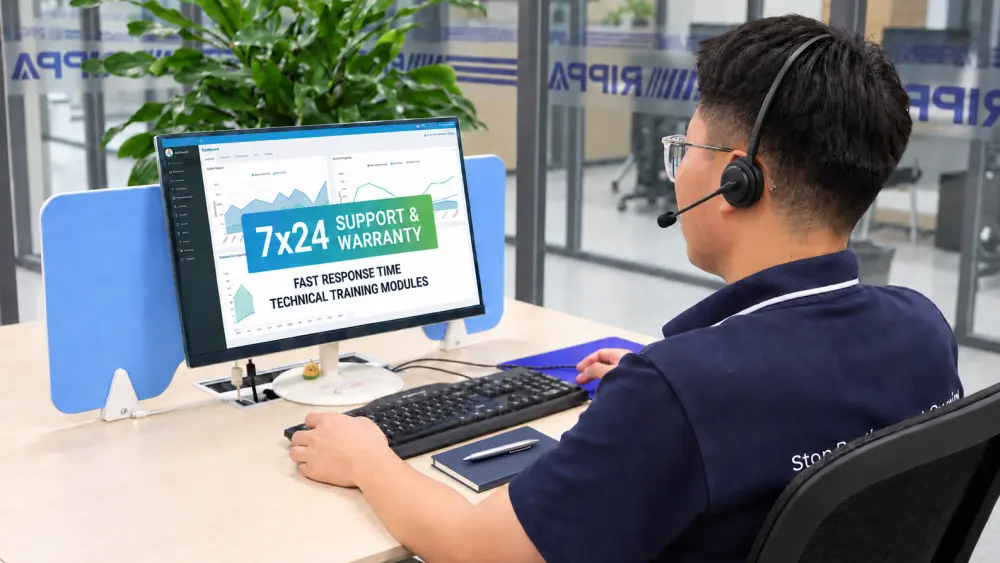
For contractors and rental businesses, downtime directly affects revenue.
For dealers, stocked equipment represents both opportunity and capital.
Every machine in the yard can help:
But every unsold machine also ties up money.
A dealer therefore needs a balance between:
stock machines + demonstration units + special-order products.
The strongest stock candidates generally have:
More specialized configurations can often remain order-based.
Dealers should track:
Equipment-dealership inventory guidance increasingly emphasizes this type of data-based approach because every unsold machine represents capital that could be used elsewhere.
A practical structure is:
Machines with proven local demand.
Machines used for customer demonstrations and lead generation.
Less common sizes and configurations.
This lets the dealer offer a wider product range without physically stocking every machine.
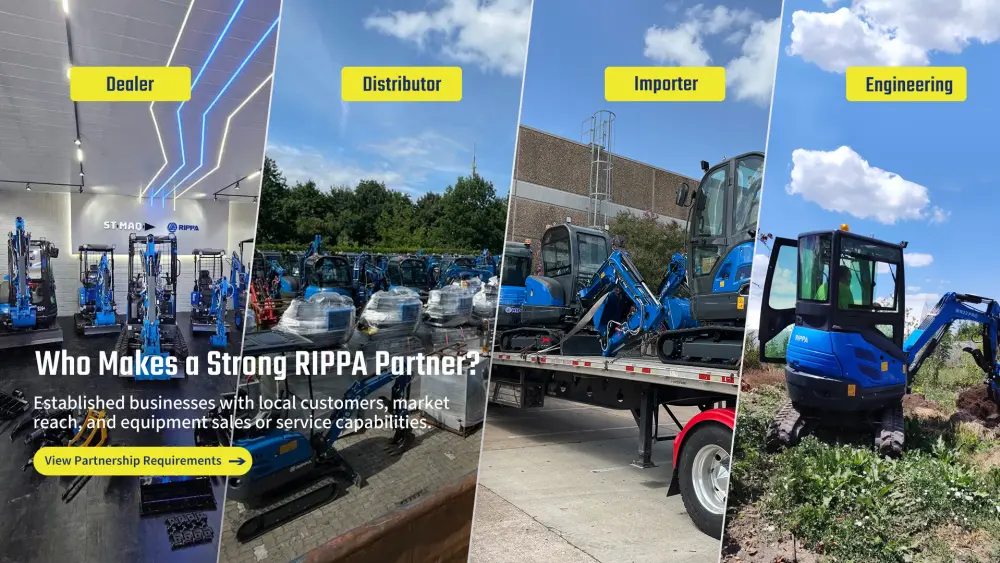
RIPPA’s current catalog includes multiple mini excavator models across compact size classes, along with skid steers, wheel loaders, forklifts, and other machinery categories.
That makes it possible for potential dealers to think in terms of:
Current inventory availability, delivery, configuration, dealer terms, warranty, parts arrangements, and territory conditions should always be confirmed directly for the relevant market.
It can be when the available machine matches your work and immediate availability creates business value.
It may be when you require a particular size, hydraulic configuration, attachment setup, or standardized fleet machine.
Application fit should come first. Delivery speed matters only after the machine is suitable for the work.
Yes. Combining core inventory with special orders can broaden customer choice while controlling inventory capital.
Confirm the exact model, operating specifications, included attachments, parts support, current warranty terms, and delivery conditions.
When searching for a мини-экскаватор for sale, buyers should not assume that the fastest machine to obtain or the most customizable machine is automatically the best choice.
Choose an in-stock mini excavator when:
Consider special ordering when:
For dealers, the same principle applies from the other side of the transaction.
Stock the machines customers repeatedly need.
Order specialized configurations when demand appears.
The strongest inventory strategy is not having every excavator in the yard.
It is making the right machine available in the right way for the customer most likely to buy it.

Авторские права: Shandong Rippa Machinery Group Co., Ltd.
Юридический представитель: Ян Хуайго | Номер лицензии: 913708000509206491
Адрес: ул. Гуанъань, д. 39, микрорайон Люхан, Зона высоких технологий, г. Цзинин, провинция Шаньдун

 Главная
 Продукция
 Электронная почта
 WhatsApp