okt 26, 2026
A new equipment dealer usually needs enough inventory to demonstrate products, satisfy common immediate-delivery demand, and support early sales without tying too much working capital into slow-moving machines.
There is no universal number of machines every new dealer should purchase.
A dealership should build inventory around:
For many new compact equipment dealers, the safest starting strategy is:
one or more core demonstration/stock machines + popular attachments + basic parts + special-order capability.
Inventory can then grow as actual sales data becomes available.
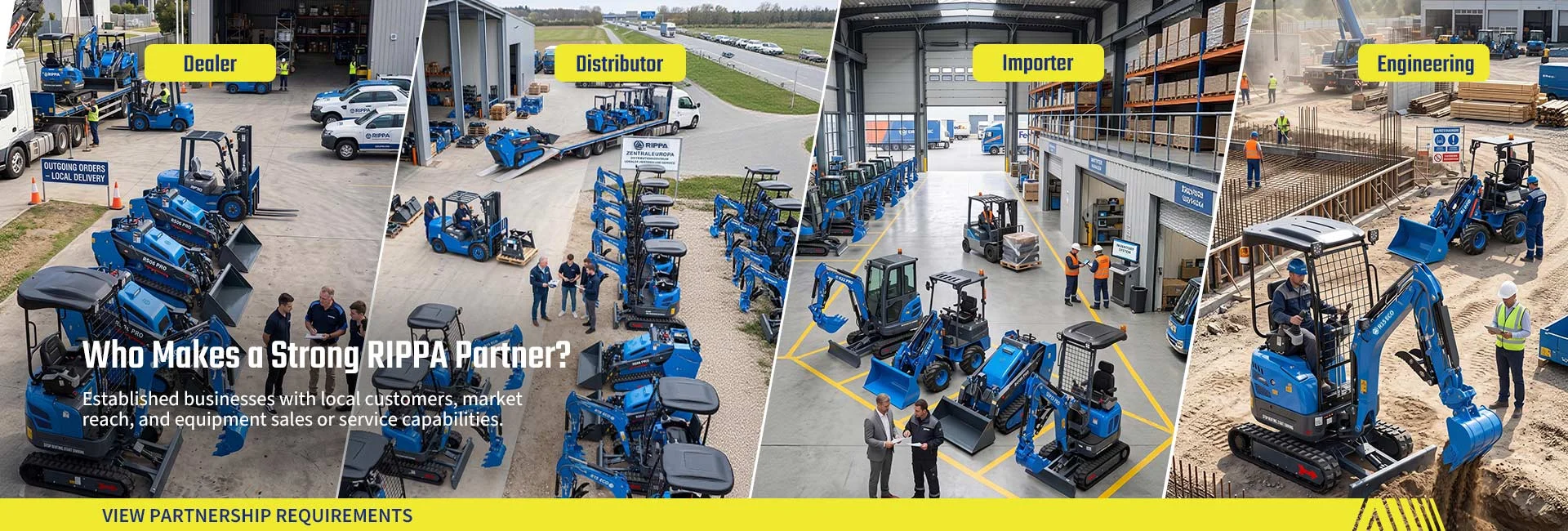
A new dealership wants to look established.
This can create pressure to fill the yard with:
But inventory is not simply a display.
It is capital.
Every machine purchased before the customer arrives reduces the cash available for:
A dealership can therefore be busy-looking and still be financially inefficient.
The opposite problem also exists.
A dealer may try to minimize risk by selling everything from a catalog.
Customers then cannot:
This can make equipment sales more difficult.
A strong starting strategy sits between those extremes.
Think in five categories.
Purpose:
For many new dealerships, a demo unit has value beyond direct resale.
These are machines with the strongest expected local demand.
Examples might include mini excavators if the dealer serves:
Core stock should focus on products that solve common customer problems.
Attachments can help convert machine inquiries into complete solutions.
Examples include:
Only common attachments need to be stocked initially.
A dealer should prepare for customer support before selling many machines.
Priority often goes to:
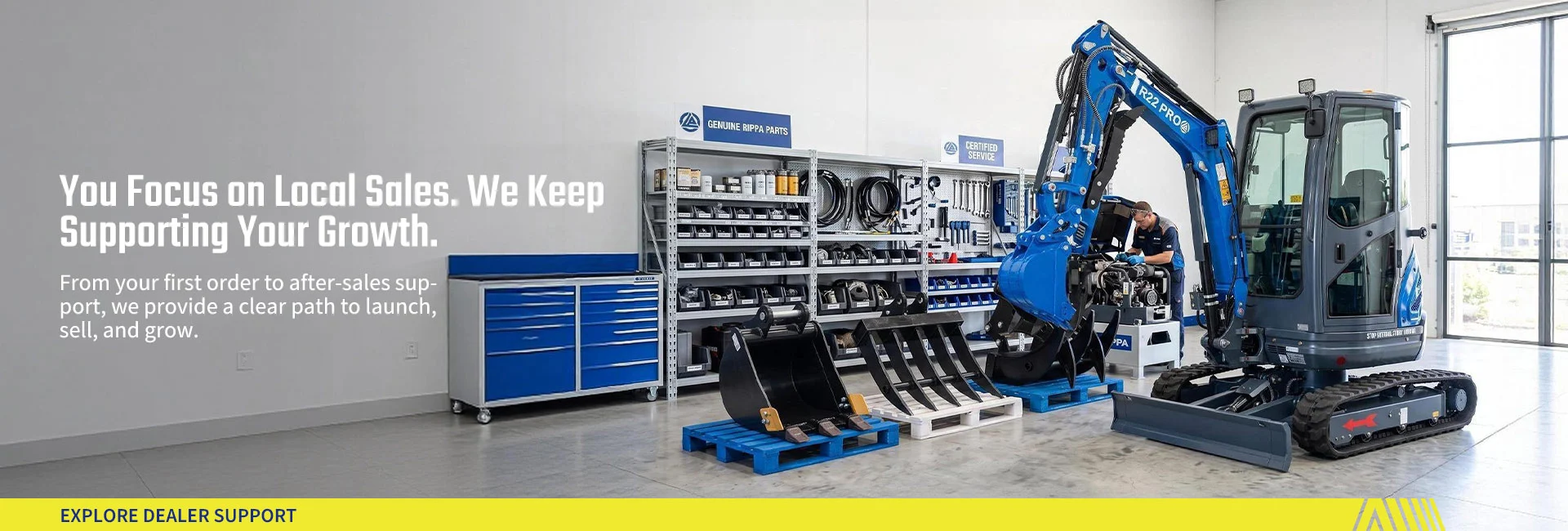
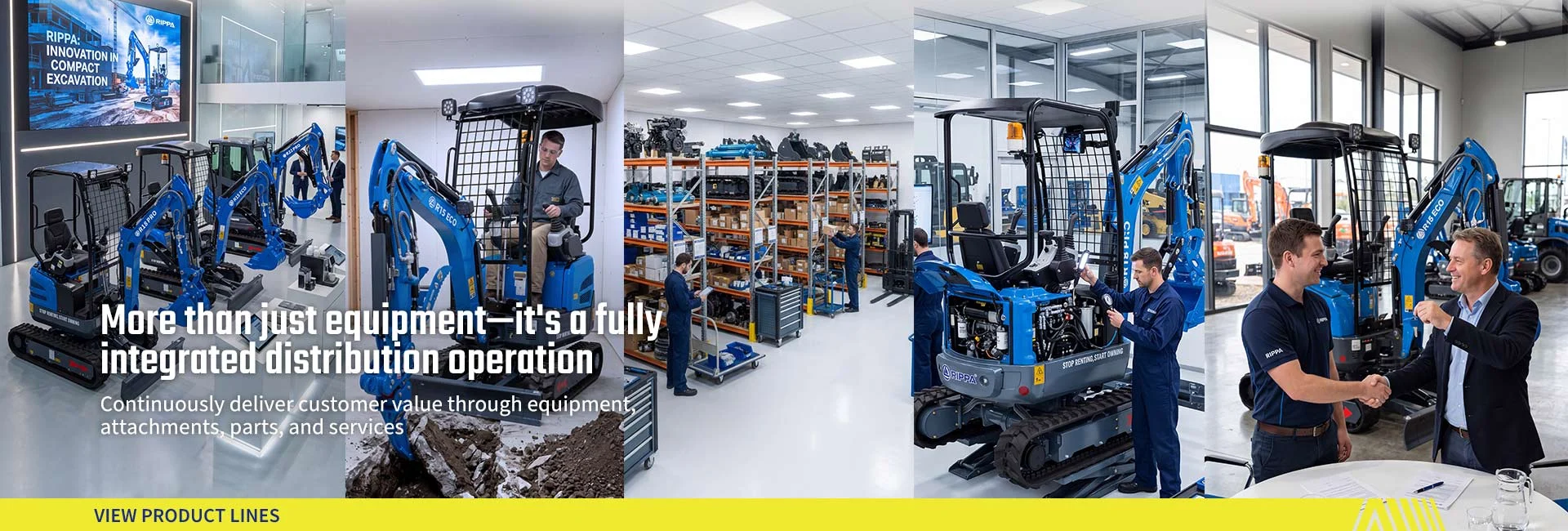
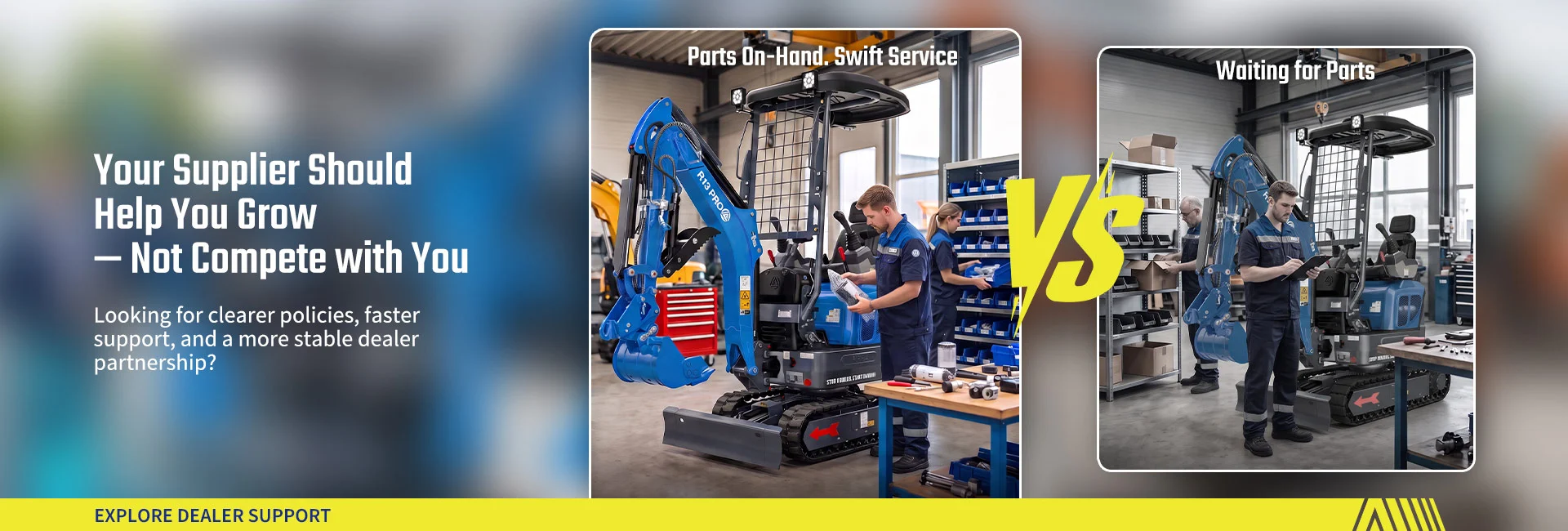
RIPPA’s current dealer-support materials describe local dealer shelves for common wear items, backed by regional warehouses and factory inventory for broader parts coverage.
The dealer should be able to serve customers who need products outside core inventory.
This prevents the business from having to physically stock:
There is no universal percentage.
The correct allocation depends on:
However, a useful principle is:
Do not invest so much in machine inventory that the dealership lacks cash to sell and support those machines.
Inventory without:
is incomplete.
Start with the category that overlaps with the largest number of existing customers.
For many compact equipment dealerships, this may be mini excavators.
Potential buyers include:
This broad customer overlap can make mini excavators a useful core product.
Their primary role is easy to understand:
digging.
Common applications include:
This makes customer conversations relatively straightforward.
The dealer can ask:
“How much digging do your customers or crews perform?”
and quickly determine whether the category is relevant.
Not automatically.
Skid steers become more relevant when customers repeatedly need:
If the dealership receives consistent demand from contractors and landscapers for those tasks, a skid steer may deserve inventory.
If demand is limited, it can remain an order-based category.
Wheel loaders are most relevant where customers regularly move:
Potential customers may include:
Again, actual customer demand should determine stocking.
Forklifts serve a different market.
They are designed primarily for:
A contractor-focused dealership may not need forklifts early.
A dealer serving:
may have a stronger case.
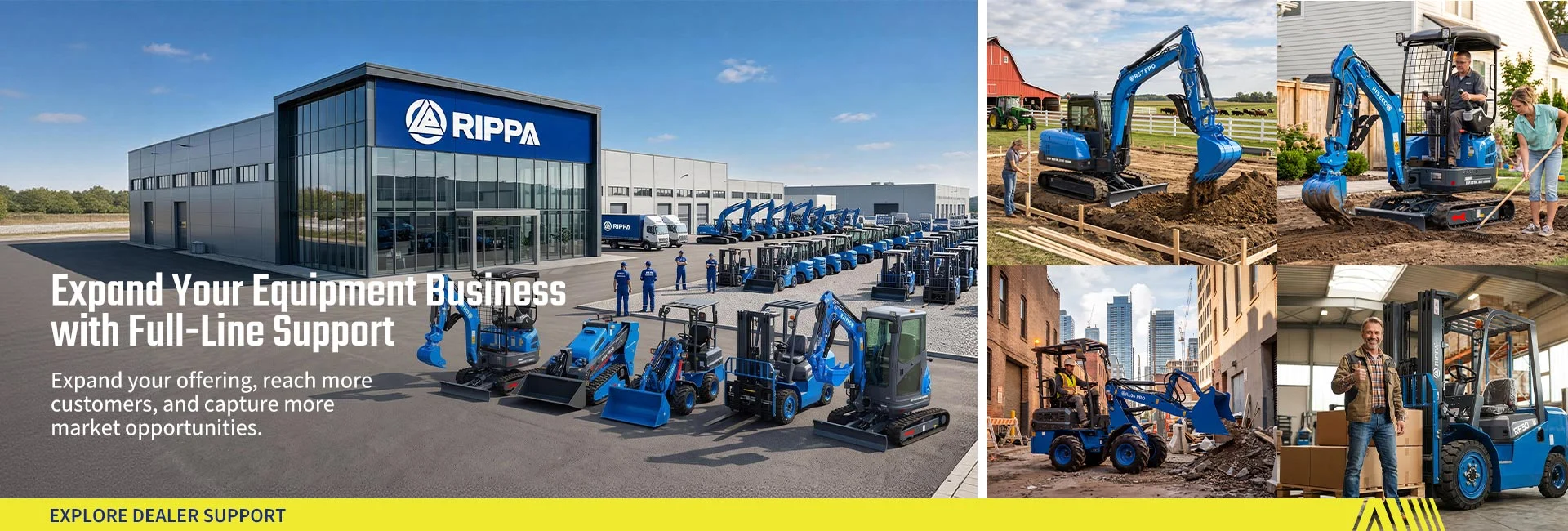
RIPPA’s current catalog includes mini excavators, skid steers, wheel loaders, forklifts, and additional equipment categories, which allows dealers to expand across different applications as customer demand develops.
One possible structure is:
Products the dealer expects to sell most frequently.
Machines used to generate leads and test emerging categories.
Reserved for:
This is only a planning framework, not a universal formula.
Actual percentages should follow the dealer’s capital structure and local demand.
Imagine a dealer stocks five machines.
Three sell quickly.
Two remain unsold.
If all working capital has already been spent, the dealer may not be able to replace the three machines customers actually want.
This creates a paradox:
The dealership has inventory but does not have the right inventory.
Keeping capital available for reordering successful products is important.
Inventory turnover describes how efficiently inventory converts into sales.
For an equipment dealership, useful questions include:
The goal is not simply to increase turnover at any cost.
The dealer also needs healthy margins and customer support.
A slow-moving machine may:
One slow machine is not automatically a mistake.
It may be a useful demo product.
But several slow machines can create significant capital pressure.
Reorder when there is evidence such as:
Do not reorder automatically because the machine looks popular online.
Local sales evidence is stronger.
Options may include:
Discounting should not always be the first solution.
Sometimes the issue is customer targeting rather than price.
A focused dealership often has an advantage early.
For example:
Mini excavators
Attachments and parts
Skid steer loaders
Wheel loaders or other products based on proven demand
This allows the dealership to develop:
before increasing complexity.
Adding another machine category means learning:
A dealership that grows product categories faster than its support capability can create customer problems.
A rental company becoming a dealer has an advantage:
It already has utilization data.
It can identify:
The business can use its rental history to guide dealership inventory.
This is much stronger than guessing.
A tractor dealer already knows rural customers.
It can ask:
This helps identify the first adjacent products worth stocking.
A trailer dealer may already serve:
Instead of buying many machines immediately, it can begin by identifying:
This customer data can guide the first stock order.
Parts inventory should grow with the installed machine population.
At the beginning, the dealer may prioritize:
RIPPA’s current dealer-support materials state that recommended local stocking can be based on the number of machines operating in the dealer’s territory, while additional parts are supported through regional and factory inventory.
Exact recommended parts lists should be confirmed for the current product lineup.
RIPPA’s current published dealer materials describe flexible stocking rather than a single rigid initial quantity. They indicate that dealers may begin with a demo unit and basic parts stock and increase inventory as market demand grows.
That can be particularly relevant for:
Current dealer approval, territory, commercial, stocking, and support terms should always be confirmed directly with RIPPA.
Before ordering inventory, answer:
| Question | Why It Matters |
|---|---|
| Who are our first customers? | Determines product category |
| What machines do they already rent? | Indicates existing demand |
| Which machine gets the most serious inquiries? | Helps identify core stock |
| How much working capital can we safely use? | Prevents overstocking |
| How long will reorders take? | Determines safety stock |
| Do we have demo capability? | Supports sales |
| What attachments are commonly requested? | Supports complete solutions |
| What parts should be local? | Supports customer uptime |
| How will slow inventory be managed? | Protects cash |
| Which products can remain special-order? | Reduces inventory pressure |
There is no fixed number. The dealership should begin with enough machines to demonstrate products and serve proven local demand without exhausting working capital.
No. Core machines can be stocked while lower-demand configurations remain special-order products.
For dealers serving contractors, landscapers, farms, and rental businesses, mini excavators can be a strong category to evaluate because they serve several customer segments.
Yes, especially frequently requested tools. Specialized attachments can be ordered when needed.
A basic parts strategy should be established early so customers can receive proper after-sales support.
When actual customer demand shows that loading, grading, cleanup, or loose-material movement are regular needs.
No. Excess inventory can tie up capital and reduce the dealer’s ability to reorder fast-selling products.
A new equipment dealer needs enough inventory to create confidence and close sales—but not enough to damage cash flow.
The strongest starting structure is often:
core machines + demo capability + common attachments + essential parts + special-order products.
For many compact equipment dealerships, mini excavators can serve as the first core category.
Additional products such as skid steers, wheel loaders, and forklifts should be added only when customer demand justifies them.
Inventory should grow according to:
The goal is not to fill the equipment yard.
The goal is to build an inventory system in which capital moves from machine stock to customer sales and back into the products the market wants next.

Copyright: Shandong Rippa Machinery Group Co., Ltd.
Legal Representative: Yan Huaiguo | License No.: 913708000509206491
Address: No. 39 Guangan Road, Liuhang Subdistrict, High-tech Zone, Jining City, Shandong Province

 Home
 Products
 Email
 WhatsApp