okt 26, 2026
Buying compact equipment becomes much easier when you stop comparing machines only by horsepower, size, or price and start with one question:
What work does the business need the machine to perform?
A mini excavator, skid steer loader, wheel loader, and forklift may all appear in equipment yards, but they solve very different problems.
In simple terms:
A contractor that needs drainage equipment should not choose a forklift because it has a good price.
A warehouse should not buy an excavator to handle pallets.
The right equipment decision begins with workflow.
This guide compares four major machine categories for contractors, landscapers, farms, rental businesses, warehouses, material suppliers, and equipment dealers.
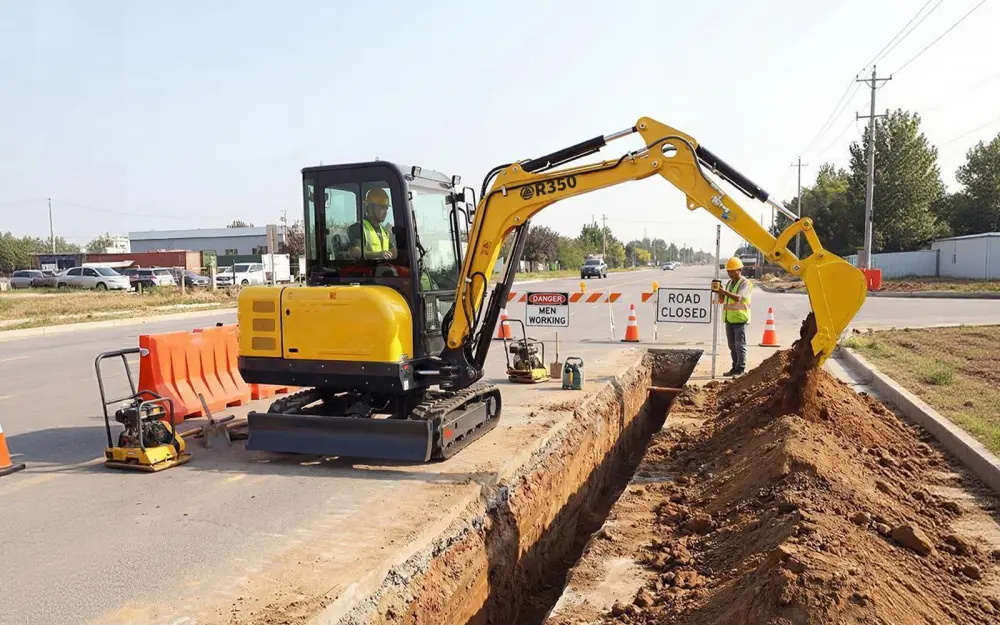
A mini excavator is designed around excavation.
Common applications include:
The boom, arm, and bucket allow the machine to work below ground level.
This is the fundamental reason it differs from loader-type equipment.
Mini excavators may suit:
The machine can be especially useful when digging appears repeatedly across customer jobs.
A skid steer serves a different role.
Typical work includes:
With suitable compatible attachments, skid steers can also perform a broad range of specialized work.
Potential users include:
A skid steer is particularly valuable when the work happens primarily above ground and involves moving or shaping material.
This is one of the most important compact equipment comparisons.
Your projects repeatedly require both excavation and material movement.
A common workflow is:
Mini excavator digs → skid steer moves material → skid steer grades and cleans.
The machines complement each other.
A wheel loader is built around efficient material handling.
Potential materials include:
Compared with an excavator, the wheel loader is not primarily a digging machine.
Compared with a skid steer, a wheel loader may be attractive when the operation emphasizes repeated material movement across a yard or larger working area.
Potential users include:
The best fit depends on machine size and application.
Both machines can move materials, but they may fit different workflows.
| Factor | Skid Steer | Wheel Loader |
|---|---|---|
| Loading | Strong | Strong |
| Tight maneuvering | Major strength depending on machine/site | Depends on machine |
| Grading | Common application | Possible depending on setup |
| Material-yard work | Useful | Often strong |
| Attachment variety | Often broad | Model-dependent |
| Longer material movement | Application-dependent | Often worth evaluating |
| Contractor cleanup | Strong | Useful depending on scale |
A contractor working on compact construction sites may prefer a skid steer.
A material yard repeatedly moving loose products may benefit more from a wheel loader.
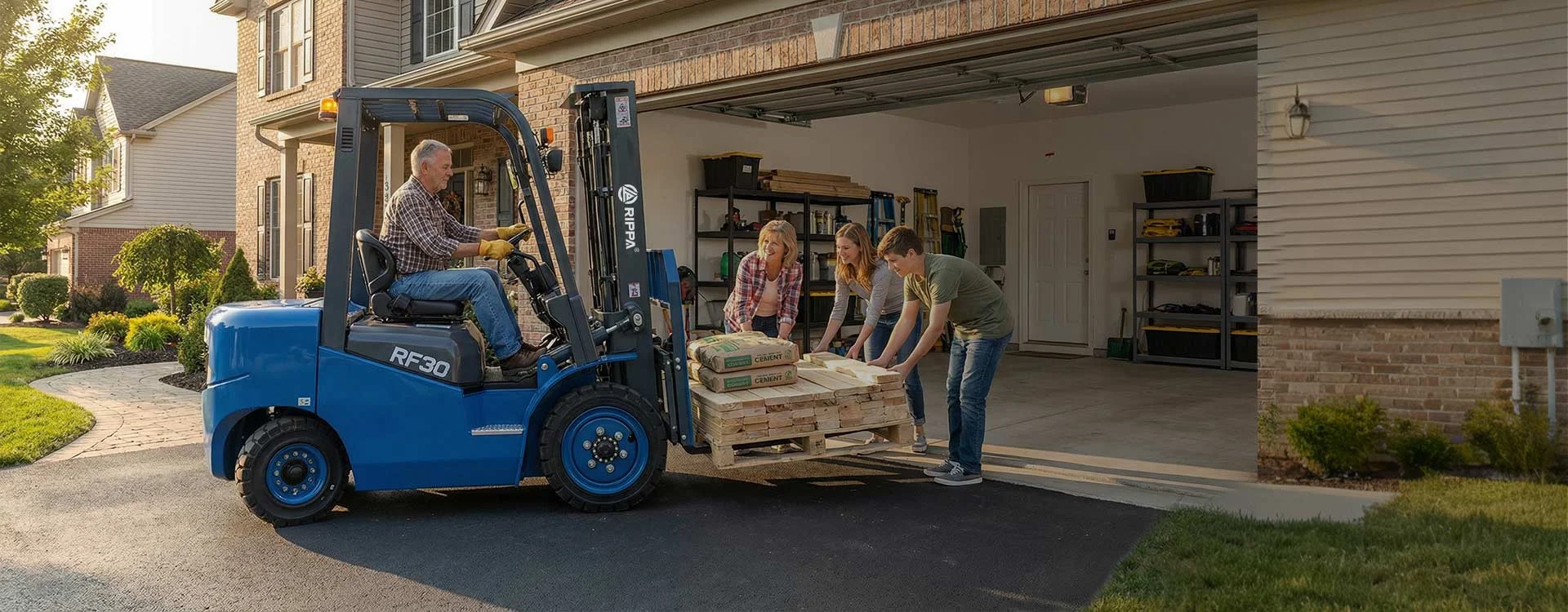
Forklifts solve a fundamentally different problem.
They are designed to:
Potential users include:
The question is what the material looks like.
Examples:
Consider loader equipment.
Examples:
Consider forklifts.
Trying to solve both jobs with one machine can reduce efficiency.
Landscaping companies may eventually need more than one category.
For:
For:
Potentially for:
For many professional landscapers, a mini excavator plus skid steer can become a particularly useful combination when workload justifies owning both.
Start with the activity the contractor performs or subcontracts most frequently.
If the business repeatedly pays others for:
consider a mini excavator.
If it repeatedly rents equipment for:
consider a skid steer.
If the business regularly manages larger quantities of loose material, compare wheel loaders.
Farms can have several equipment needs.
For:
For:
For:
For:
The correct equipment depends on what the farm handles every week rather than what appears most versatile in a catalog.
Rental companies should use utilization data.
Look at:
A machine with a high rental rate but low utilization may underperform a less expensive machine that stays booked.
Possible fleet logic:
Prioritize:
Evaluate:
Evaluate:
The fleet should reflect local demand.
Use this decision tree:
Mini excavator
Skid steer
Wheel loader
Forklift
If two tasks occur frequently, compare the economics of owning two specialized machines against one machine trying to perform both roles.
Attachments can greatly expand equipment applications.
Possible mini excavator tools include:
Skid steers can also support multiple compatible work tools.
However, attachments do not eliminate the fundamental differences between machine types.
A skid steer with an attachment does not become identical to an excavator.
A loader does not become a forklift simply because it can lift certain materials.
Choose the correct base machine first.
There is no universal winner.
ROI depends on:
A mini excavator that works five days per week may be a better investment than a wheel loader that works twice per month.
In another business, the result may be reversed.
The best ROI comes from matching equipment to repeated paid work.
Not immediately.
A dealer should first identify its dominant customer base.
May prioritize:
May evaluate:
May prioritize:
May eventually offer several categories.
The product mix should grow alongside customer demand and service capability.
Core inventory should generally focus on machines with:
Less common machines can be handled through:
This helps protect dealer capital.
Imagine a dealer has a fixed amount of inventory capital.
Putting too much money into:
can prevent the business from reordering the excavators or skid steers customers actually want.
Good inventory planning asks:
Which machines convert capital into customer sales most efficiently?
Useful measures include:
Industry inventory guidance emphasizes that dealerships should use these types of metrics to identify where capital is tied up and which machines are actually performing commercially.
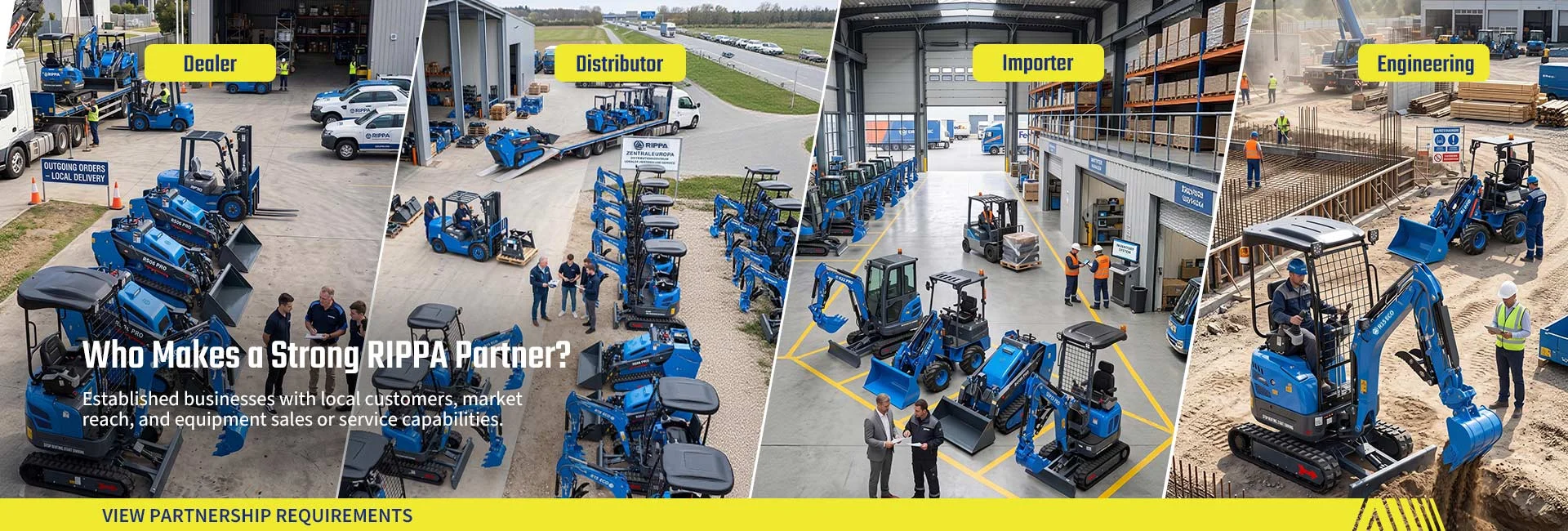
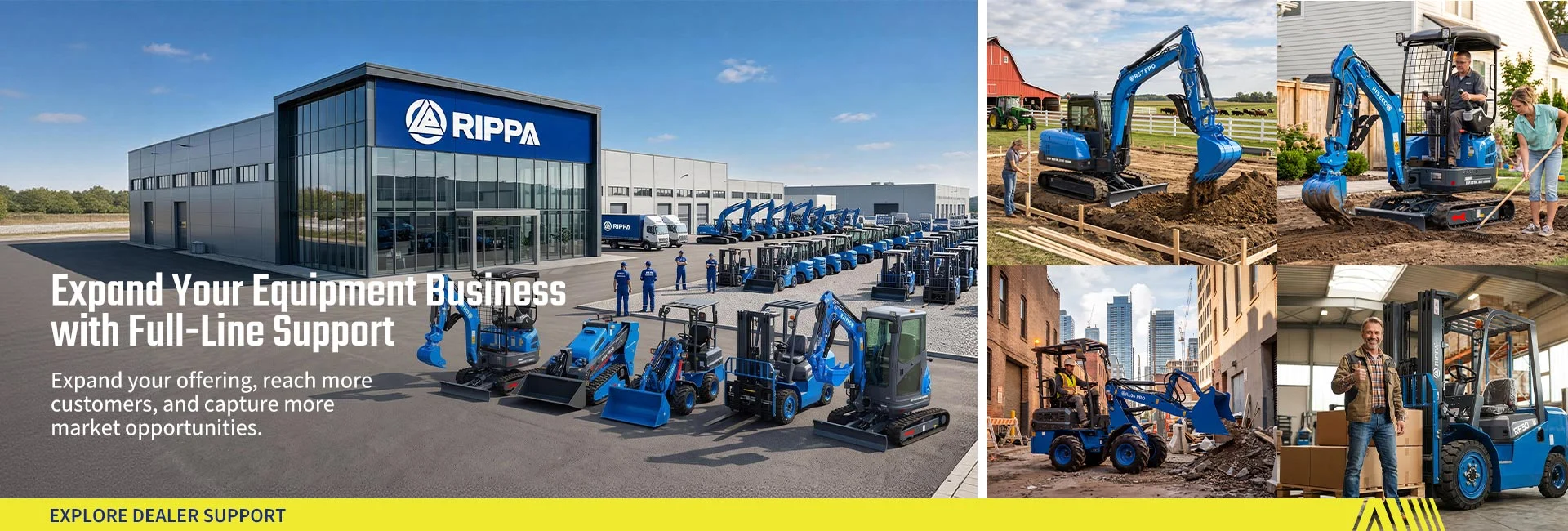
RIPPA’s current catalog includes Mini Excavator, Skid Steer, Wheel Loader, Rippa Forklift, and additional equipment categories, allowing dealers and commercial buyers to build product choices around different applications.
Its current skid steer catalog, for example, covers multiple sizes and configurations aimed at construction and agricultural applications.
Current models, specifications, inventory, attachments, parts arrangements, dealer requirements, and commercial terms should be confirmed before final purchasing or stocking decisions.
| Business Need | First Equipment to Evaluate |
|---|---|
| Digging | Mini excavator |
| Trenching | Mini excavator |
| Drainage | Mini excavator |
| Loading | Skid steer / wheel loader |
| Grading | Skid steer |
| Site cleanup | Skid steer |
| Loose-material movement | Wheel loader |
| Pallet handling | Forklift |
| Specialized tasks | Suitable compatible attachments |
For digging and trenching, a mini excavator is generally the stronger choice. For loading, grading, and cleanup, a skid steer is generally more appropriate.
It depends on the work. Skid steers are highly useful on compact sites, while wheel loaders may be attractive for repeated loose-material movement.
Not for most applications. Forklifts are designed primarily for palletized loads, while wheel loaders handle loose materials.
Many small contractors evaluate mini excavators and skid steers first because those machines address common excavation and material-handling tasks.
Rental companies should prioritize machines supported by actual local booking and utilization data.
No. Start with categories that match the existing customer base and expand when demand is proven.
Choosing between a mini excavator, skid steer, wheel loader, and forklift becomes much easier when each machine is connected to a specific problem.
Use:
For equipment buyers, this prevents expensive purchasing mistakes.
For rental companies, it improves fleet utilization.
For dealers, it provides a much stronger inventory strategy.
Instead of trying to stock every machine available, build the product line around what customers actually do.
That creates a more efficient path from one core product category to a broader compact equipment business.

Copyright: Shandong Rippa Machinery Group Co., Ltd.
Legal Representative: Yan Huaiguo | License No.: 913708000509206491
Address: No. 39 Guangan Road, Liuhang Subdistrict, High-tech Zone, Jining City, Shandong Province

 Home
 Products
 Email
 WhatsApp