
Mar 04, 2026
Choose electric if: You operate primarily indoors, prioritize low noise and zero emissions, have access to charging infrastructure, and want lower long-term operating costs. Electric forklifts now account for over 70% of new sales, with lithium-ion batteries becoming the dominant choice for multi-shift operations .
Choose internal combustion (IC) if: You work exclusively outdoors on rough terrain, need continuous 24/7 operation without charging breaks, or require maximum power for heavy loads over 5 tons. Diesel remains the standard for ports, lumber yards, and construction sites .
The reality: Most buyers today choose electric. The total cost of ownership advantage has become undeniable—electric forklifts save $5,000–$10,000 over 5 years compared to equivalent IC models, even with higher upfront costs .
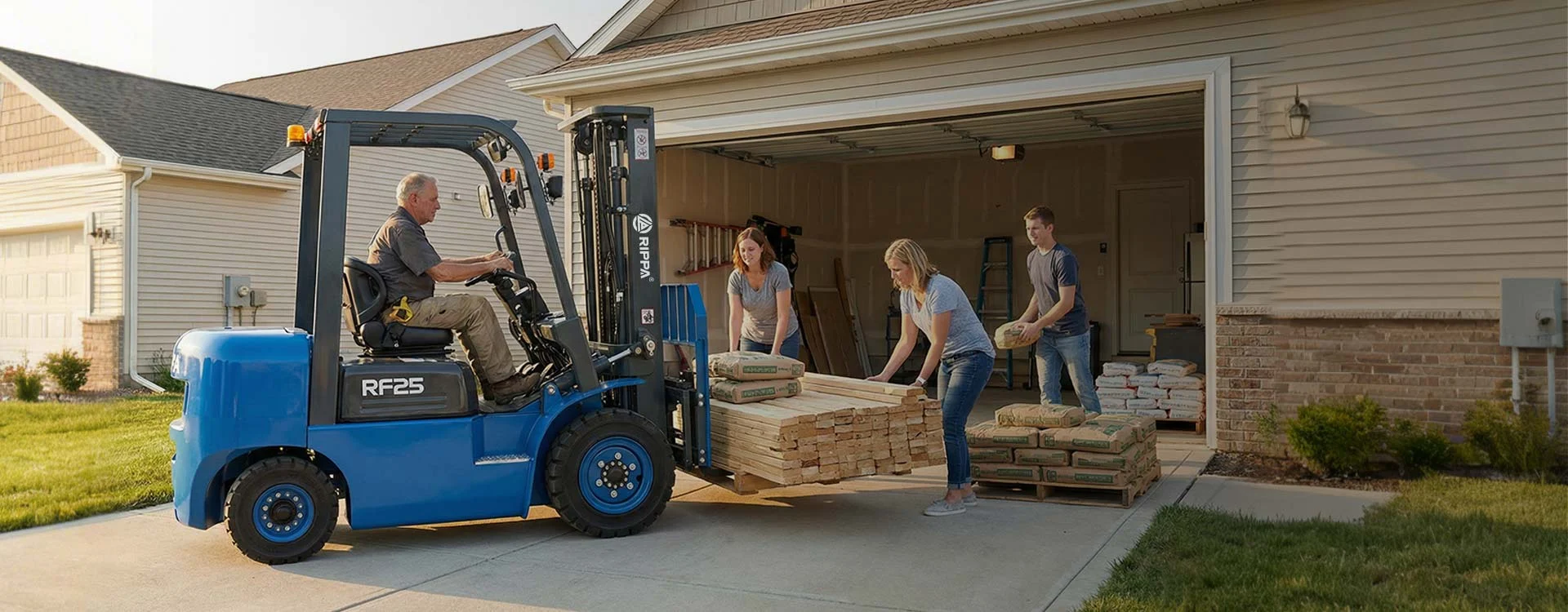
Electric forklifts have dominated new sales since 2023, with market share exceeding 70% in 2025 . Three sub-types dominate the market:
| Type | Best For | Key Advantage | Consideration |
|---|---|---|---|
| Lead-Acid Battery | Single-shift, budget-conscious | Lowest upfront cost | 8+ hour charge time, weekly maintenance |
| Lithium-Ion | Multi-shift, high utilization | 1–2 hour fast charging, no maintenance | 2–3× higher upfront cost |
| AGV/Automated | Repeatable routes, 24/7 operations | Labor savings, consistency | Requires system integration |
Real-world data: Lithium-ion batteries now last 3,000+ cycles (8–10 years) compared to 1,500 cycles for lead-acid. Opportunity charging during breaks is safe with lithium but damages lead-acid batteries .
IC forklifts remain essential for specific applications:
| Fuel Type | Best For | Pros | Cons |
|---|---|---|---|
| Diesel | Heavy outdoor, ports, construction | Maximum power, fuel efficiency | Emissions, noise |
| LP Gas | Mixed indoor/outdoor with ventilation | Cleaner than diesel | Fuel cost higher than electric |
| Gasoline | Light outdoor, occasional use | Familiar refueling | Least efficient |
Key insight: Diesel forklifts consume $2.80–$3.50 per hour in fuel, while electric equivalents cost just $0.30 per hour in electricity—a 10× difference that adds up to $5,000+ annually for multi-shift operations .
| Type | Application | Typical Cost | Channel Width |
|---|---|---|---|
| Pallet Jack | Flat-floor transport | $3,500–$5,800 | 2.0–2.3 m |
| Stacker | Low-height stacking | $6,000–$9,000 | 2.0–2.3 m |
| Reach Truck | Narrow-aisle warehousing | $25,000–$40,000 | 1.5–1.8 m |
| Counterbalance | Universal indoor/outdoor | $18,000–$35,000 | 2.5–3.5 m |
| Rough Terrain | Construction, lumber | $30,000–$60,000 | 3.5–4.5 m |
The Chinese forklift market is dominated by three major players, with growing international presence :
| Brand | Market Position | Core Strength | Best For |
|---|---|---|---|
| Anhui Heli | Market leader (30%+ share) | Heavy-duty, reliability | Industrial, continuous use |
| Hangcha | Strong #2 | Full product line | General warehousing |
| EP Equipment | Electric specialist | “Xiaojingang” pallet trucks | E-commerce, logistics |
Second-tier specialists:
BYD: Vertically integrated lithium-ion batteries, ideal for multi-shift operations
Noblelift: Strong mid-range electric options after Manitou acquisition
Tailift: Taiwanese brand, 20% lower cost than top tier
Third-tier options: Dalian (heavy-duty regional), Jialift, Jingjiang (budget options for occasional use) .
| Tier | Price Range | Brands | Risk Level |
|---|---|---|---|
| Premium | $30,000–$60,000 | Heli, Hangcha, BYD | Lowest |
| Mid-Range | $20,000–$35,000 | EP, Noblelift, Tailift | Moderate |
| Economy | $12,000–$22,000 | Regional brands | Highest |
Important: For high-intensity operations (multi-shift, daily use), choosing a first-tier brand pays for itself in reduced downtime and better parts availability .
Based on industry data and buyer surveys, these six errors account for 80% of purchase regrets .
The problem: Buyers focus on purchase price, ignoring that operating costs often exceed the machine’s value over 5 years.
The solution: Calculate 5-year TCO including:
Purchase price
Fuel/electricity ($0.30/hour electric vs. $2.80/hour diesel)
Maintenance ($400/year electric vs. $2,100/year IC)
Battery replacement (every 3–5 years for lead-acid)
Resale value (30–50% of purchase price for quality brands)
Real example: A $25,000 electric forklift with $400/year operating cost beats a $18,000 diesel with $2,800/year operating cost within 3 years .
The problem: Buyers choose lead-acid for lower upfront cost, then struggle with charging downtime and maintenance.
The solution: Match battery to your shift pattern :
| Usage Pattern | Recommended Battery | Rationale |
|---|---|---|
| Single shift, occasional use | Lead-acid | Lowest entry cost |
| Single shift, heavy use | Lithium-ion | Opportunity charging during breaks |
| Multi-shift | Lithium-ion | Fast charging between shifts |
| 24/7 operations | Swappable lithium | Hot-swap for continuous operation |
The problem: A forklift that doesn’t fit your warehouse is useless, yet 35% of buyers fail to measure their tightest aisle .
The solution: Measure before you buy:
Aisle width: Standard counterbalance needs 3.5–4.0 m
Right-angle stack width: Critical for warehouse layout
Doorway clearance: Include mirrors and attachments
Test method: Use ASTM D5607 standard to verify turning radius claims .
The problem: Buyers purchase a bare forklift, then discover attachments aren’t compatible or require expensive modifications.
The solution: Plan for attachments upfront:
Side shifters: Essential for precise placement, should be standard
Hydraulic quick coupler: Enables 30-second attachment changes
Auxiliary hydraulics: Required for rotators, clamps, and specialized tools
Note: Adding auxiliary hydraulics after purchase costs 2–3× factory installation .
The problem: A cheap machine with no local parts support becomes an expensive paperweight when it breaks.
The solution: Verify before purchase :
Dealer proximity: Can they reach you within 4 hours?
Parts inventory: Do they stock common wear items locally?
Service contracts: What SLA do they offer (24–48 hour response)?
Technician training: Factory-certified or general mechanics?
The problem: Operations grow, but the forklift can’t scale—too small, wrong energy type, no automation readiness.
The solution: Consider future needs :
Modular design: Can you upgrade components later?
Automation ready: Does it support AGV conversion?
Fleet compatibility: Same brand simplifies training and parts
Resale value: Will it hold value when you upgrade?
Best choice: Electric pallet jack or stacker
Investment: $5,000–$8,000
Annual operating cost: $400–$600
ROI timeline: 12–18 months through labor savings
Key specs:
1,500–2,000 kg capacity
2.0–2.3 m aisle requirement
6+ hour battery life
Best choice: Electric counterbalance with lithium battery
Investment: $25,000–$35,000
Annual operating cost: $600–$1,000
ROI timeline: 18–24 months
Key specs:
2,500–3,500 kg capacity
3.0–3.5 m aisle requirement
Opportunity charging capability
Best choice: Electric counterbalance + specialized attachments
Investment: $30,000–$45,000
Annual operating cost: $800–$1,200
Attachments: Side shifter, fork positioner essential
Consideration: Match battery to shift patterns—lithium for multi-shift operations.
Best choice: Diesel counterbalance or rough terrain
Investment: $35,000–$60,000
Annual operating cost: $3,000–$5,000
ROI timeline: 2–3 years based on utilization
Key specs:
5,000+ kg capacity
Pneumatic tires
High ground clearance
Best choice: Cold-spec electric with heated battery
Premium: +$15,000–$25,000 over standard
Requirements: Sealed electronics, low-temp grease, heated battery compartment
| Factor | Detail |
|---|---|
| Upfront cost | $2,500–$4,000 (48V) |
| Lifespan | 1,500 cycles (3–5 years) |
| Charge time | 8+ hours + cooling |
| Maintenance | Weekly watering, equalization |
| Opportunity charging | Damages battery |
| Energy efficiency | 80% |
| Factor | Detail |
|---|---|
| Upfront cost | $8,000–$12,000 |
| Lifespan | 3,000+ cycles (8–10 years) |
| Charge time | 1–2 hours |
| Maintenance | None |
| Opportunity charging | Safe and recommended |
| Energy efficiency | 95% |
The math: Lithium pays for itself in multi-shift operations. A $9,000 lithium battery saves $1,300/year in maintenance labor and eliminates 2 hours daily charging downtime .
Fast-charge: 15 minutes charging = 4 hours operation
Swappable: 2-minute battery swap for 24/7 operations
Energy recovery: Regenerative braking captures energy
| Component | Electric | IC Engine |
|---|---|---|
| Oil changes | N/A | $150–$250/250 hrs |
| Filter replacements | N/A | $200–$300/500 hrs |
| Battery service | $0–$200/year | N/A |
| Brake service | $300–$600/year | $500–$800/year |
| Tire replacement | $1,000–$2,000/3 years | $1,000–$2,000/3 years |
Industry benchmark: Electric forklifts cost 60–70% less to maintain than IC models .
| Task | Electric | IC Engine |
|---|---|---|
| Daily visual check | ✓ | ✓ |
| Battery water (lead-acid) | Weekly | N/A |
| Grease fittings | Monthly | Monthly |
| Tire pressure check | Monthly | Monthly |
| Brake inspection | 500 hrs | 500 hrs |
| Hydraulic oil change | 1,000 hrs | 1,000 hrs |
| Engine oil/filter | N/A | 250–500 hrs |
| Transmission service | N/A | 1,000 hrs |
When buying, demand :
Response time: 4 hours for emergency calls
Repair time: 24–48 hours to resolve
Parts availability: 90%+ in-stock rate locally
Warranty on repairs: 6–12 months minimum
Application:
What is the heaviest load? (add 25% safety margin)
What is the lift height? (highest rack + 6″)
Indoor or outdoor? (or both?)
What is the tightest aisle width?
Single shift or multi-shift operation?
What attachments will you need (now or future)?
Financial:
What is your 5-year total cost of ownership target?
Have you calculated fuel vs. electricity cost?
What is your maintenance budget?
What resale value do you expect?
Supplier:
Is there an authorized dealer within 50 miles?
Do they stock common parts locally?
What is their service response SLA?
Are technicians factory-certified?
What warranty is offered? (2+ years is standard)
Test procedure :
Cold start (IC) – Easy? Smoke?
Full lift cycle – Smooth? Drift at height?
Travel test – Both directions? Turning radius?
Brake test – Stopping distance?
Attachment test – If equipped
Hour meter – Consistent with service records
Fluid check – Clean, full, no leaks
Tire condition – Even wear, sufficient tread
A: With proper maintenance :
Electric forklifts: 10–15 years (battery replacement every 5–8 years)
IC forklifts: 8–12 years before major overhauls
Heavy commercial use: 5–8 years
A: Consider :
New if: Mission-critical application, multi-shift use, want latest safety tech
Used if: Light duty, backup machine, limited budget, inspected by professional
Used inspection essential: Check hour meter, battery health, mast condition, tire wear, service records.
A: Ranked by value :
Side shifter (10–15% efficiency gain)
Hydraulic quick coupler (30-second attachment changes)
Fork positioner (if handling varied pallets)
Attachments based on application (rotator, boom, clamps)
A: Formula :
Labor savings: Manual labor cost × hours saved
Efficiency gain: Current throughput × improvement %
Contractor avoidance: Costs you won’t pay
Residual value: Estimated resale after 5 years
Example: $28,000 forklift with $8,000/year savings = 3.5-year payback.
A: OSHA classifications :
Class I: Electric counterbalance
Class II: Electric narrow aisle
Class III: Electric pallet jack/stacker
Class IV: IC counterbalance (cushion tires)
Class V: IC counterbalance (pneumatic tires)
| Your Situation | Recommended Type | Brand Tier | Budget Range |
|---|---|---|---|
| Small warehouse, occasional | Electric pallet jack | Economy/mid | $5,000–$8,000 |
| Medium warehouse, single shift | Electric counterbalance (lead-acid) | Mid/premium | $18,000–$25,000 |
| Large warehouse, multi-shift | Electric counterbalance (lithium) | Premium | $30,000–$45,000 |
| Manufacturing, continuous | Electric counterbalance (lithium) + attachments | Premium | $35,000–$50,000 |
| Outdoor, rough terrain | Diesel counterbalance | Premium | $35,000–$60,000 |
| Cold storage | Cold-spec electric | Premium | $45,000–$70,000 |
| Automated operations | AGV forklift | Premium | $50,000–$100,000+ |


 Beranda
 Produk
 Email
Email
 WhatsApp