Eki 04, 2026
Construction equipment dealerships do not always begin as construction equipment dealerships.
Many successful businesses enter new markets by following their existing customers.
A company selling tractors notices farmers asking for excavators.
A trailer dealer notices contractors buying trailers to move compact machinery.
A rental business notices customers repeatedly renting the same machines.
A used equipment dealer sees demand for new alternatives.
A landscaping equipment company watches customers move from lawn maintenance into drainage, grading, and hardscape projects.
These are not random opportunities.
They are examples of adjacent-market expansion.
For established businesses with customers, capital, facilities, and commercial experience, adding compact equipment can provide a path into machinery distribution without starting from zero.
RIPPA’s current product catalog includes mini excavators, skid steer loaders, wheel loaders, forklifts, and other machinery categories, providing multiple possible product directions for B2B partners whose customer bases extend beyond one application.
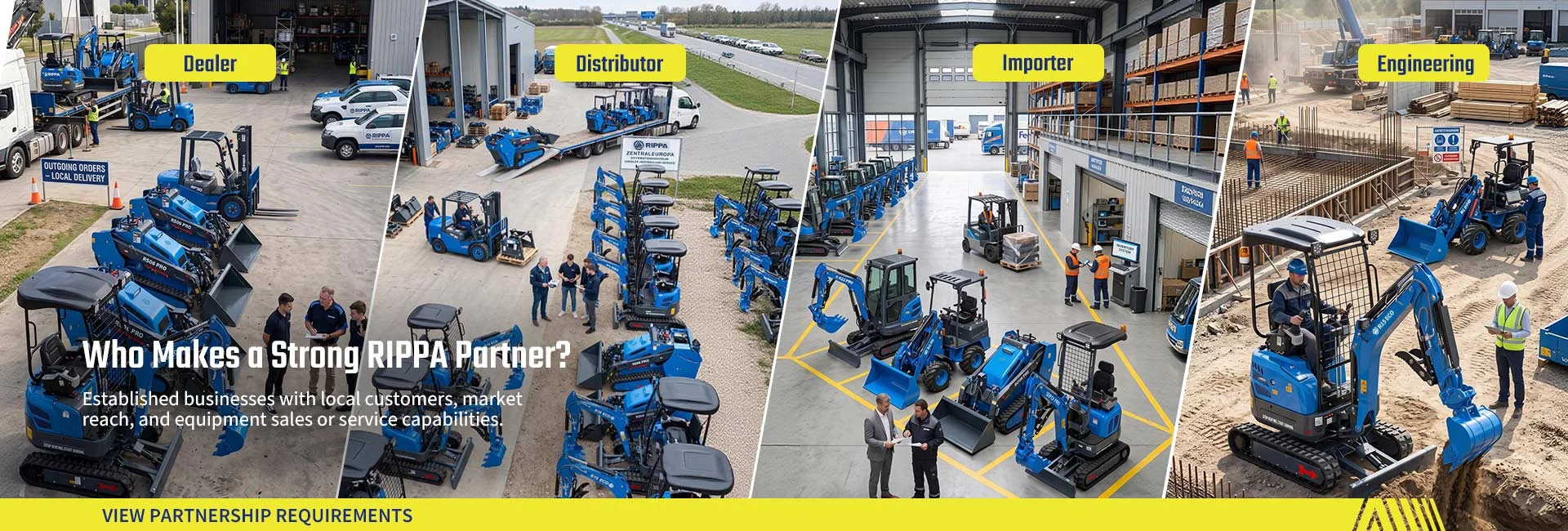
A business may be a strong candidate when it already has several of these assets:
The closer its existing customers are to equipment users, the easier the transition may be.
Agricultural dealerships are one of the clearest adjacent markets.
They already sell to customers who:
Their customers may need:
This can create a natural compact equipment extension.
For many farm-focused dealers:
Mini EKSKAVATÖR first → loader products later according to demand.
Trailer dealers have strong customer overlap with compact equipment sellers.
Their buyers may include:
These customers already move machinery.
A trailer dealership with adequate space and support capability can potentially add:
This allows the dealer to sell equipment to people already visiting the business for transportation solutions.
Used equipment businesses already understand:
Adding selected new equipment can broaden their customer offering.
For example:
A customer may visit looking for a used mini EKSKAVATÖR but prefer a new alternative after comparing:
A mixed new-and-used business can serve more purchasing profiles.
Rental businesses have one major advantage:
They already know what customers actually use.
Their own reservation data may reveal:
They may also know which renters are potential equipment buyers.
A company that rents mini excavators every month may eventually sell machines to:
Rental and retail can reinforce each other.
Many landscaping dealers begin with:
Professional landscape customers may eventually need:
This can create demand for:
For the dealer, compact construction machinery becomes the next stage of serving the same customer.
Not every lawn-equipment company should become a machinery dealership.
However, businesses serving professional commercial customers rather than primarily homeowners may have an opportunity.
A customer that begins as a mowing company may eventually become a:
Its equipment needs become larger as the business grows.
The dealer can grow with that customer.
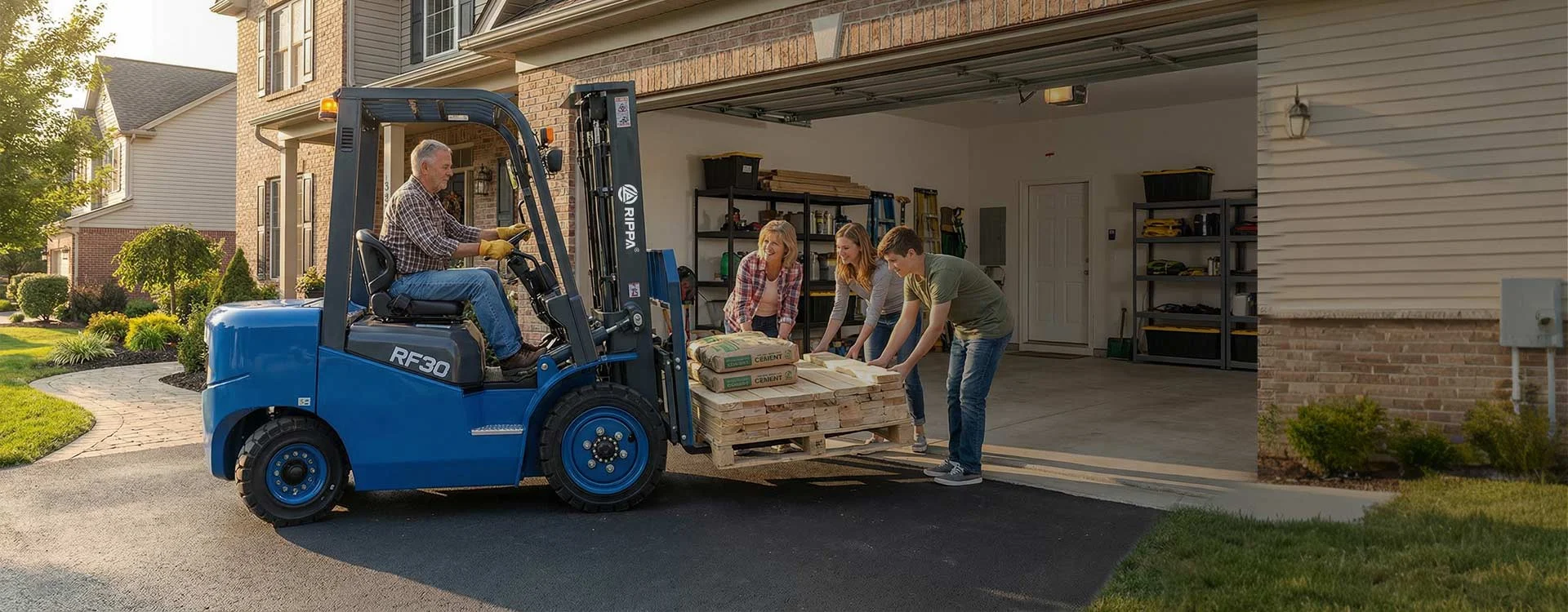
Forklift dealers already operate in a machinery environment.
Many have:
A forklift business may expand into compact construction machinery when it wants to reach:
Its existing machinery infrastructure can reduce the difficulty of expansion.
Building material yards often serve contractors every day.
Customers may buy:
Those same contractors also use machines.
A material supplier may therefore have strong customer access even though it has no previous equipment-sales experience.
Potential product opportunities may include:
The correct category depends on the customer’s work.
Businesses selling:
may already serve landscapers and contractors.
They may also use equipment themselves.
This creates two perspectives:
If customers frequently ask about the machines being used in the yard, that can indicate potential demand.
Professional hardware companies may have thousands of contractor accounts.
Their current products may be smaller, but their customer relationships are valuable.
Moving into machinery requires additional expertise, but the distributor may already understand:
Compact equipment can become a strategic expansion rather than simply a product extension.
Industrial distributors often have strong commercial sales operations.
If they serve sectors such as:
they may have opportunities for equipment sales.
For example:
The business can develop equipment by customer segment.
Truck and commercial vehicle dealers may already serve:
These customers also purchase equipment.
However, the machinery category should match the customer base.
For example:
A contractor-heavy dealership may explore compact construction equipment.
A logistics-heavy dealership may have more natural overlap with forklifts.
Customer analysis should guide the decision.
Importers may already have:
These businesses can potentially become:
rather than only retail dealerships.
They can be especially valuable partners when they already distribute adjacent machinery categories.
A wholesale business may have access to:
Instead of selling directly to every end customer, it may develop a regional dealer network.
This business model requires:
but may support larger-scale distribution.
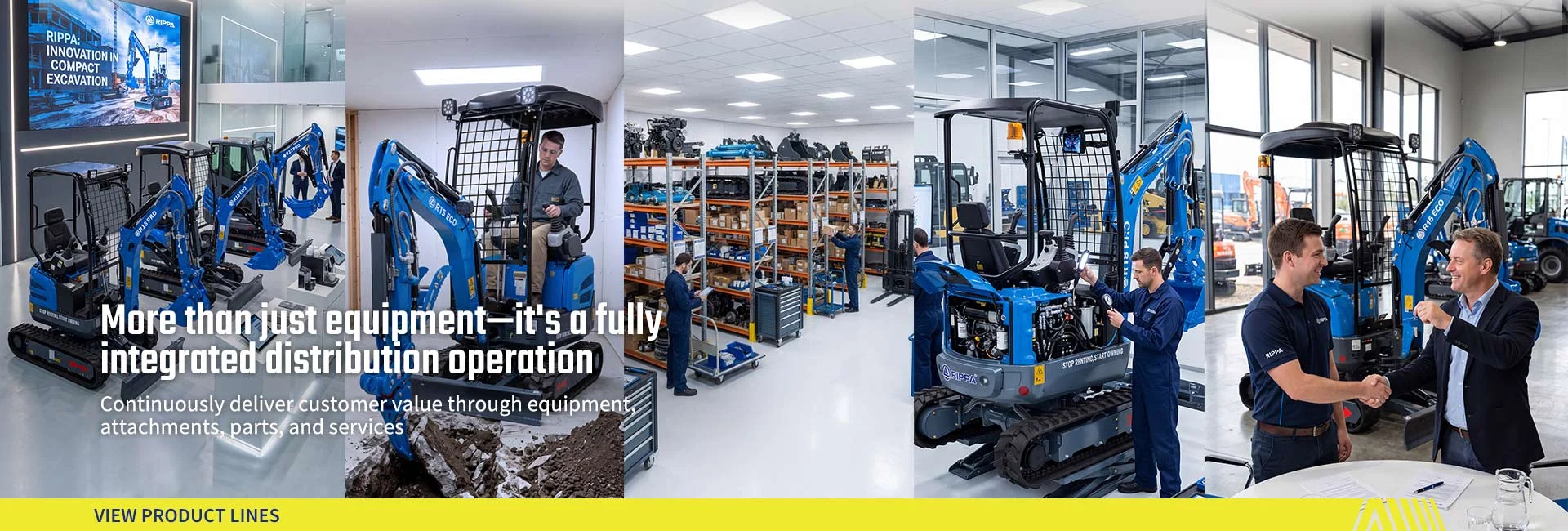
Established contractors sometimes reach a point where they understand machinery better than many ordinary buyers.
They know:
They may also have extensive relationships with other contractors.
A contractor with commercial resources may therefore consider machinery distribution as a secondary business.
Larger maintenance businesses may already use:
They also interact with:
Although not every maintenance business should become a dealer, larger operators may have useful customer networks.
Some transport companies specialize in moving:
These companies often know local equipment dealers and owners.
However, logistics knowledge alone is not enough.
A transport company considering equipment sales would still need:
Its transportation infrastructure is an advantage, not a complete dealership model.
A business owner may have no direct machinery background but still possess:
Such an entrepreneur may be able to build a dealership by combining existing business skills with machinery training and support.
The key is whether the market can be developed professionally.
Start with customer problems.
| Customer Problem | Product Direction |
|---|---|
| Kazı ve hendek açma | Mini EKSKAVATÖR |
| Loading and site cleanup | Mini yükleyici |
| Loose-material movement | Wheel loader |
| Pallet handling | Forklift |
| Specialized jobs | Compatible attachments |
This keeps the product strategy practical.
Mini excavators can serve several of the highest-priority dealer-recruitment segments:
RIPPA’s current mini excavator catalog spans several compact machine sizes, making it possible to evaluate different configurations for different B2B customer profiles.
This gives a new dealer multiple market directions while still keeping one central product category.
Consider them when customers frequently ask for:
RIPPA’s current product catalog includes multiple skid steer models as part of its broader equipment offering.
They can complement excavators on contractor and landscaping projects.
Wheel loaders may be relevant when customers regularly handle:
RIPPA currently lists wheel loader models across several size classes, making the category relevant to agricultural, construction, and material-handling applications depending on the customer’s needs.
Forklifts make more sense when the dealer serves customers with:
This is a different application from excavation.
The dealership should add forklifts because customers need pallet handling—not simply because the product exists.
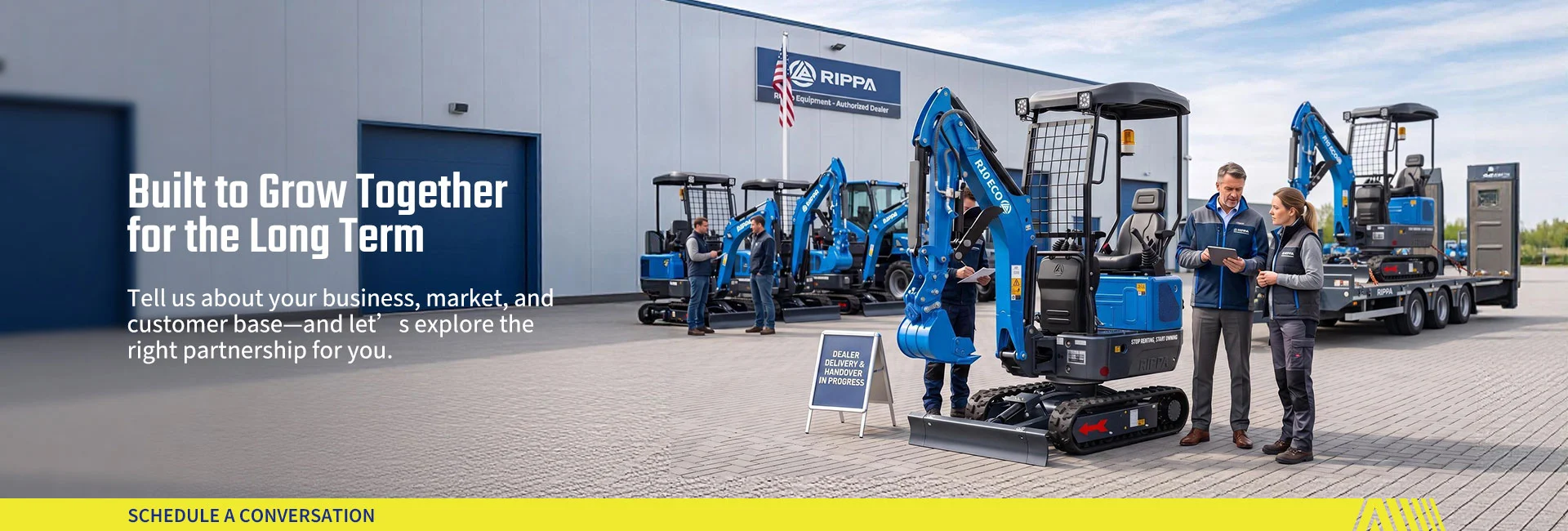
Before fully committing, a business can:
Find out:
Review:
Avoid excessive inventory.
Let qualified customers see the equipment.
Separate price shoppers from real B2B buyers.
Use sales data rather than assumptions.
Not always.
An existing business may be able to introduce compact equipment as an additional division or product category, depending on:
These should be reviewed locally before expansion.
A business should ask:
“Do people who already buy from us also buy or rent machinery?”
If the answer is yes, there may be a meaningful opportunity.
Examples:
Trailer customer → mini excavator buyer.
Tractor customer → mini excavator buyer.
Rental customer → equipment buyer.
Landscape equipment customer → mini excavator buyer.
Forklift customer → potential loader or material-handling equipment buyer.
Existing customer overlap can make expansion significantly more practical.
Potential candidates include tractor dealers, trailer dealers, rental companies, used equipment dealers, landscape equipment businesses, forklift dealers, building material suppliers, industrial distributors, importers, contractors, and established entrepreneurs.
Not necessarily, but product knowledge and after-sales capability must be developed.
For businesses serving contractors, farms, landscapers, and rental customers, mini excavators can provide a strong starting category.
No. Product expansion should follow customer demand.
Existing customer relationships. A company that already serves relevant B2B customers does not need to build its market completely from zero.
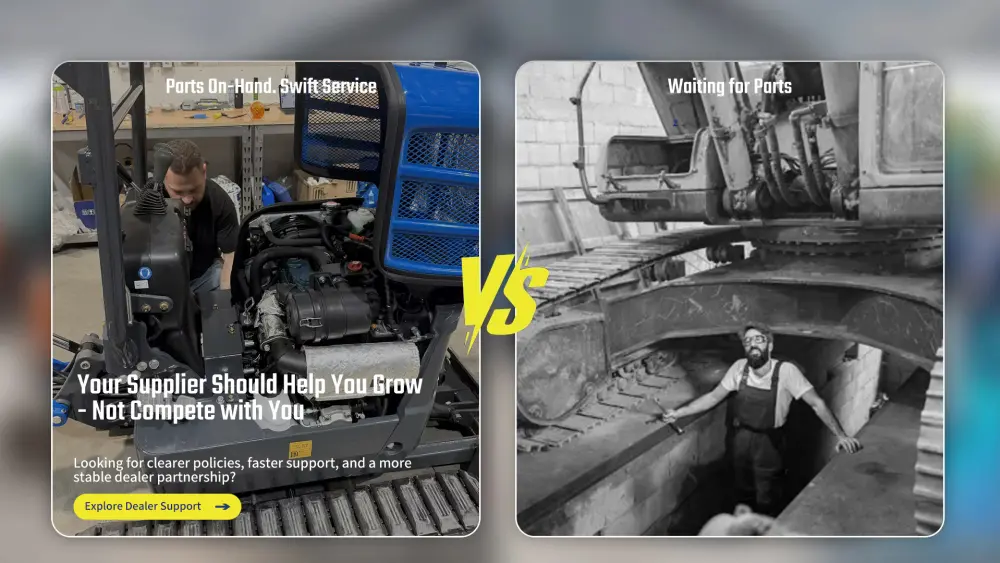
The next generation of compact equipment dealers may come from many industries.
They may already sell:
Or they may operate:
What makes them attractive potential equipment dealers is not their current job title.
It is the combination of:
customers + resources + capital + sales capability + local relationships + willingness to build after-sales support.
For these businesses, compact machinery can become a logical next stage of growth.
The best opportunity often begins with the customers the business already has—and the equipment those customers are already trying to buy.

Telif Hakkı: Shandong Rippa Machinery Group Co., Ltd.
Yasal Temsilci: Yan Huaiguo | Ruhsat No.: 913708000509206491
Adres: Shandong Eyaleti, Jining Şehri, Yüksek Teknoloji Bölgesi, Liuhang Alt Bölgesi, Guangan Caddesi, No. 39

 Ev
Ev
 Ürünler
 E-posta
 WhatsApp