
feb. 04, 2026
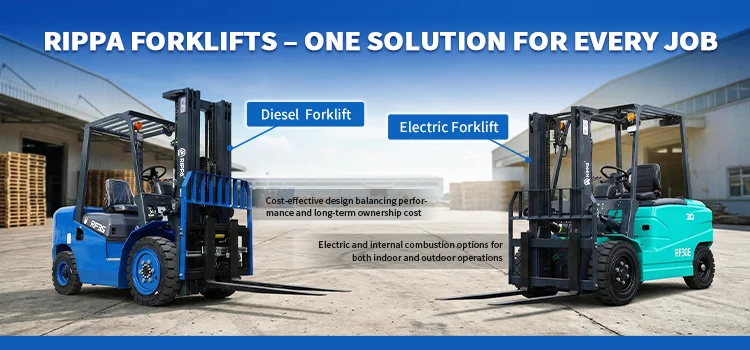
The economic superiority of electric forklifts is built upon decisive advantages in three key cost areas: energy consumption, maintenance, and often-overlooked “hidden” value.
The most straightforward and calculable saving comes from energy costs. While prices fluctuate, electricity in Europe has historically shown greater price stability compared to diesel or liquefied petroleum gas (LPG). More importantly, its cost per energy unit is typically lower for equivalent work output.
Cost Per Charge vs. Cost Per Tank: An electric forklift like the Rippa RF15E, powered by a 60V / 75Ah battery pack, can complete a full shift on a single charge in many applications. The cost of this electricity is significantly less than refuelling a comparable IC forklift. Over a year of multi-shift operation, this differential compounds into substantial savings.
Elimination of Ancillary Fuel Costs: Electric operation completely removes the costs and risks associated with fuel handling. There is no need for on-site fuel storage tanks, specialized dispensing equipment, spill containment systems, or the associated insurance and safety management overhead. This represents not just direct cost savings but also a reduction in administrative burden and regulatory compliance complexity.
This is where electric forklifts deliver a knockout blow. An internal combustion engine is a complex assembly of hundreds of moving parts—pistons, belts, filters, injectors—all requiring regular lubrication, adjustment, and replacement. This translates to frequent, scheduled maintenance and a higher probability of unexpected failures.
In stark contrast, the Rippa RF15E features a fully-AC drive system. AC motors have a revolutionary advantage: they contain no brushes or commutators that wear out and require periodic replacement. This single design feature drastically reduces routine maintenance needs. There are no spark plugs to change, no oil filters to replace, no engine oil to dispose of, and no exhaust system to maintain. The maintenance schedule is overwhelmingly simplified, focusing primarily on periodic checks of brakes, hydraulics, and the battery. The result is twofold:
Lower Planned Maintenance Costs: Reduced parts and labour expenses for scheduled services.
Minimised Unplanned Downtime: Fewer moving parts subject to wear mean a significantly lower chance of a catastrophic failure halting your operations. Higher uptime directly protects productivity and revenue.
Beyond the direct line items on a budget sheet, electric forklifts generate considerable value that impacts the bottom line indirectly but powerfully.
Improved Indoor Air Quality & Employee Health: IC forklifts emit carbon monoxide, nitrogen oxides, and particulate matter directly into the warehouse environment. Electric forklifts produce zero local emissions. This improves air quality, protecting employee health, reducing sick days, and creating a more pleasant workplace, which aids in recruitment and retention.
Drastic Noise Reduction: Electric forklifts operate far more quietly than their IC counterparts. This reduces noise pollution, minimises operator fatigue and stress, and improves communication and safety on the floor.
Regulatory Future-Proofing: European emissions standards (like EU Stage V for non-road machinery) are becoming increasingly stringent. Urban low-emission zones are expanding. Investing in a zero-emission electric fleet proactively addresses these regulations, ensuring uninterrupted access to all operating areas and avoiding potential future penalties or retrofitting costs.
Enhanced Brand Image: Demonstrating a commitment to clean technology strengthens a company’s sustainability credentials, an increasingly important factor for clients, investors, and the community.
The economic case for electric forklifts in Europe is clear and compelling. By offering dramatically lower energy and maintenance costs while eliminating a suite of ancillary expenses and risks, they deliver a lower Total Cost of Ownership. The Rippa RF15E, with its efficient AC power system and robust design, embodies this value proposition, providing a reliable and low-risk entry point for operations embarking on their electrification journey.
Choosing electric is no longer just an environmental statement; it is a sound financial strategy that aligns operational efficiency with sustainability goals. It represents an investment in a cleaner, quieter, and more cost-effective future for European logistics.
Understanding the economic logic of electrification is the first step. The next is to see how the equipment itself is designed to empower your operators and maximise these advantages. Continue reading to discover how the Rippa RF15E’s human-centric design directly translates into enhanced productivity.


 Acasă
Acasă
 Produse
 E-mail
 WhatsApp