3 iulie 2026
Choose a wheel loader if you need higher lift capacity, faster travel speed, better performance on uneven terrain, and lower operating costs over the long term. Choose a skid steer if you need extreme maneuverability in very tight spaces, lower initial purchase price, and the ability to work on paved surfaces without causing damage. Wheel loaders typically last 6,000 to 8,000 hours compared to 3,000 to 5,000 hours for skid steers.
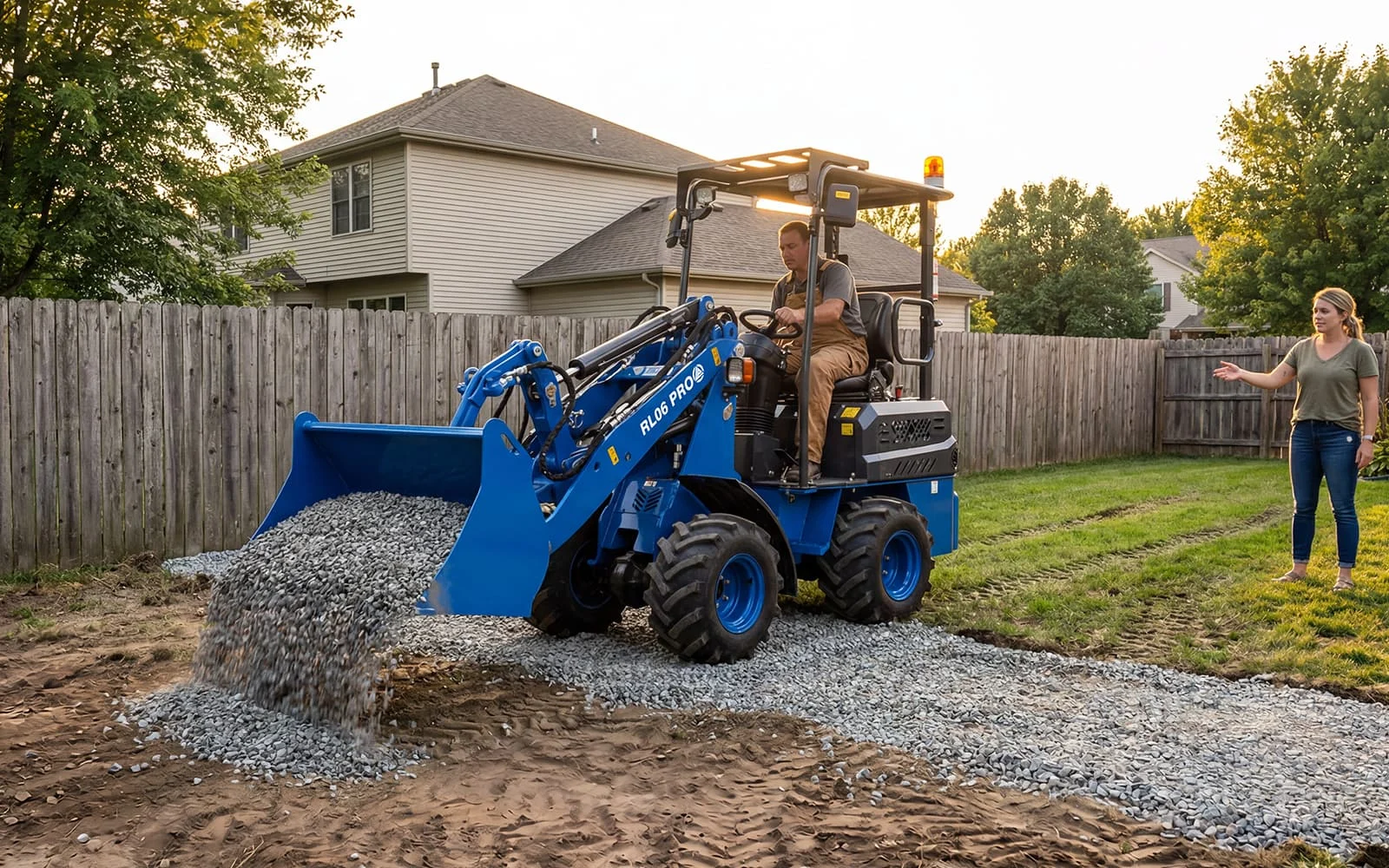
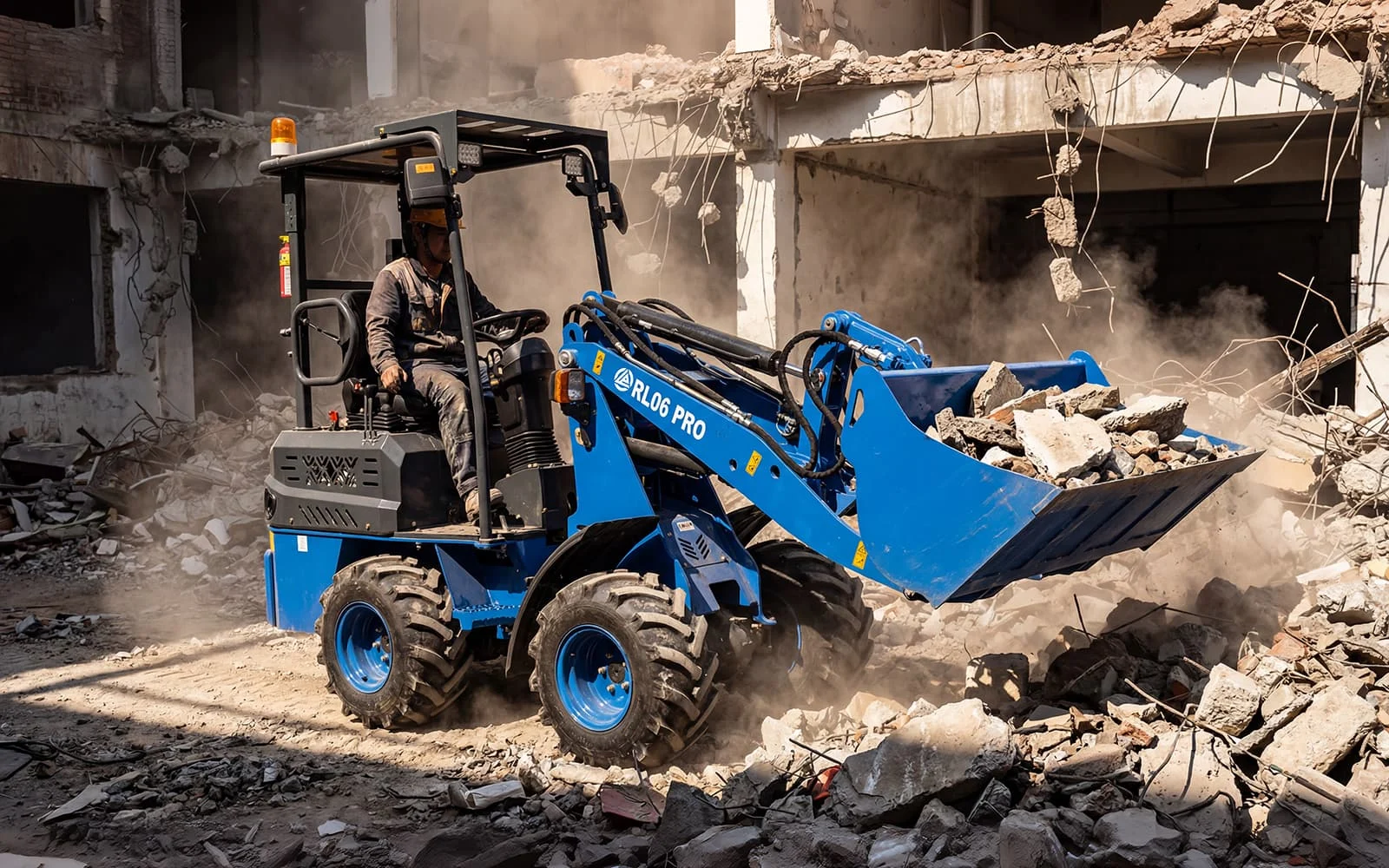
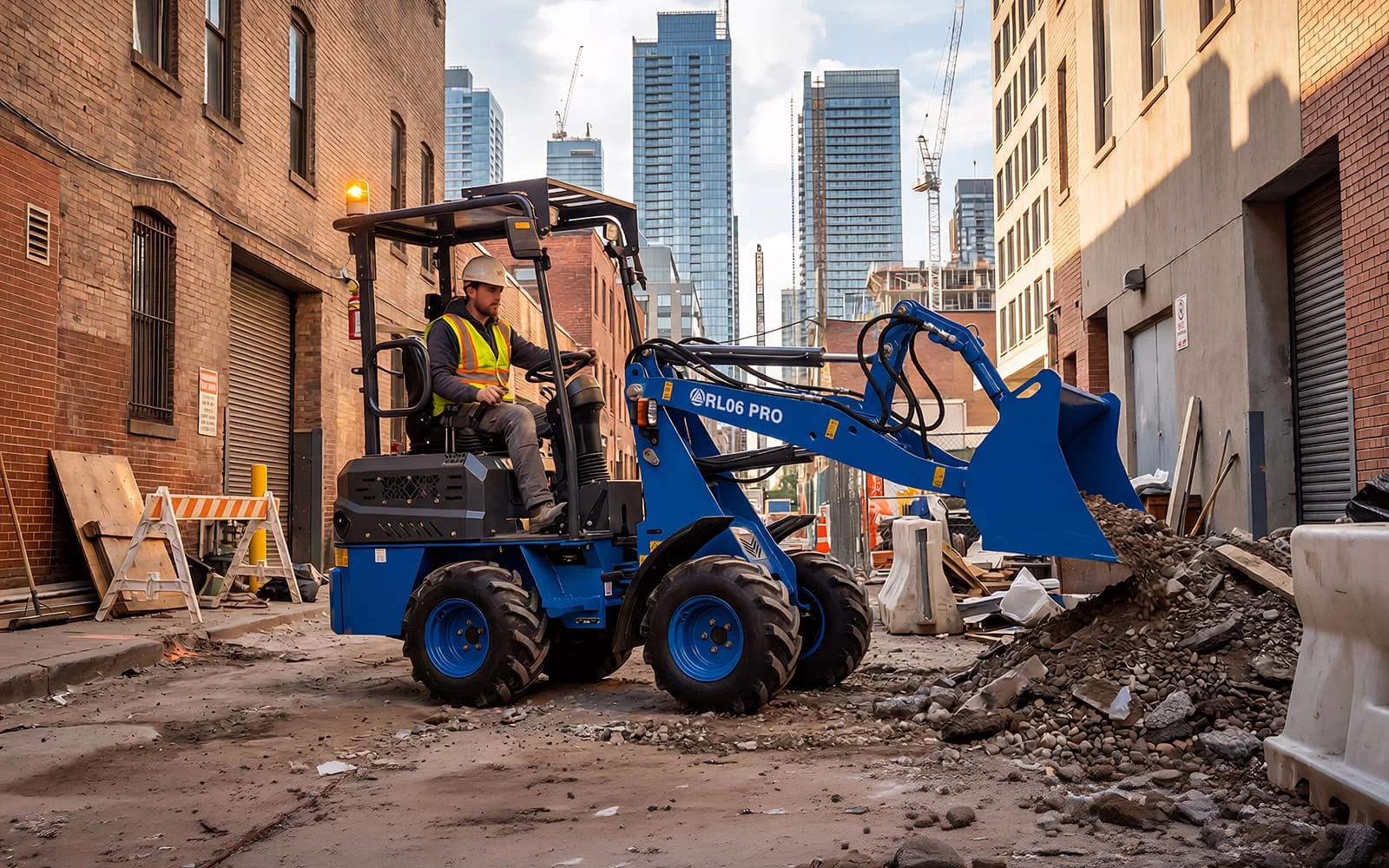
A wheel loader is an articulated machine with a hinge between the front and rear frames. It steers by bending at the hinge. All four wheels stay on the ground during turns. The Rippa RL series is a wheel loader. The articulated design provides strong power, small steering angle and turning radius, better passing ability, and flexible operation.
Wheel loaders are larger and heavier than skid steers of similar capacity. They have a higher lift height and greater reach.
A skid steer loader is a rigid-frame machine with wheels on each corner. It steers by driving the wheels on each side at different speeds. This causes the machine to skid or slide around corners. Skid steers have a zero turning radius.
Skid steers are smaller and lighter than wheel loaders. They are highly maneuverable in tight spaces.
| Caracteristică | Wheel Loader | Skid Steer |
|---|---|---|
| Steering | Articulated, bends at center | Skid steer, wheels skid |
| Turning radius | Larger, but still tight | Zero turning radius |
| Lift capacity | Higher for size | Lower for size |
| Lift height | Mai mare | Mai jos |
| Viteza de deplasare | Faster, up to 40 km/h | Slower, up to 20 km/h |
| Terrain capability | Excellent on uneven ground | Good on flat ground |
| Ground disturbance | Less | More |
| Operator comfort | More spacious cab | Smaller cab |
| Design life | 6,000 to 8,000 hours | 3,000 to 5,000 hours |
| Prețul de achiziție | Mai mare | Mai jos |
| Operating cost per hour | Mai jos | Mai mare |
| Maintenance complexity | Moderat | Moderat |
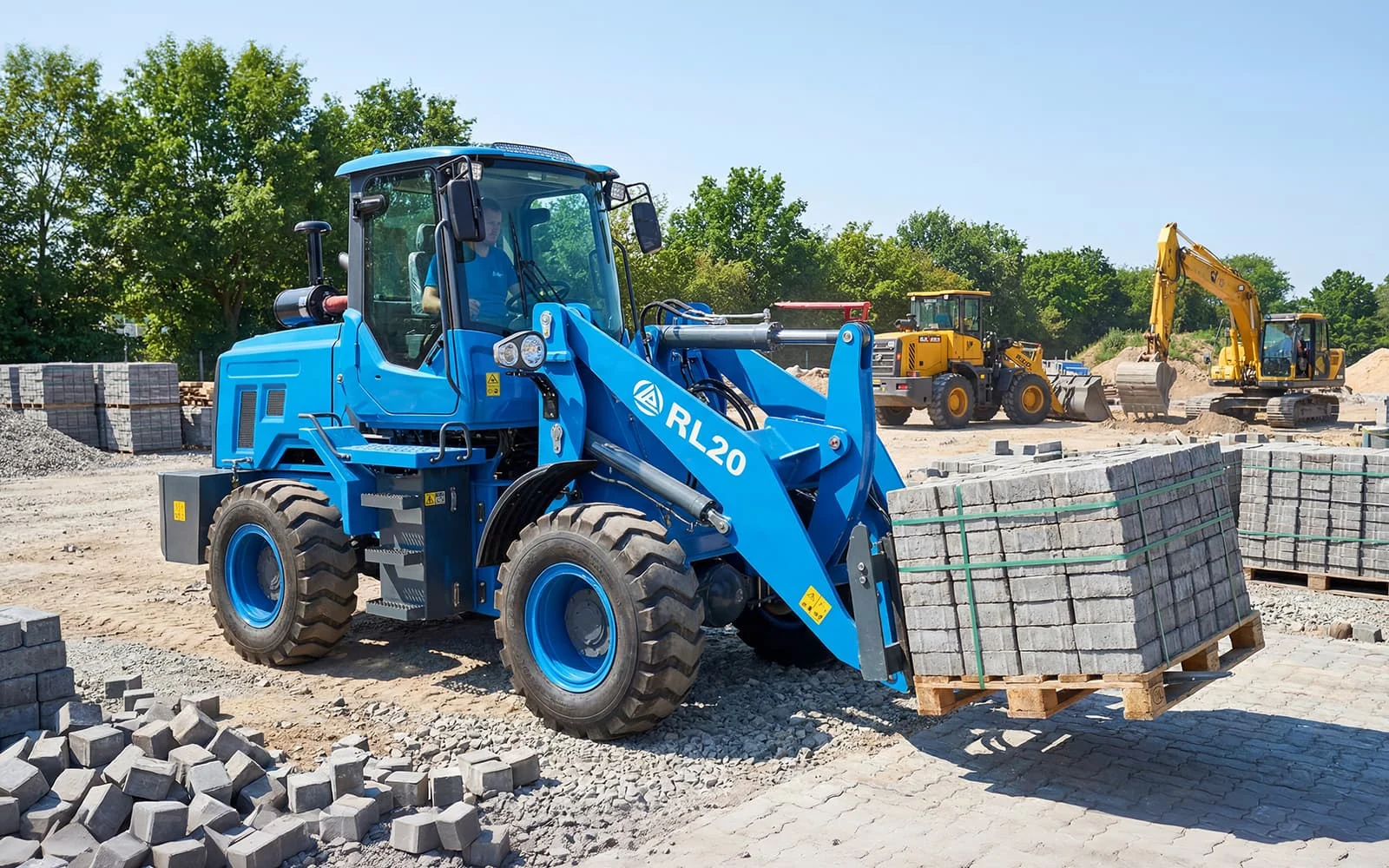
Wheel loaders have higher lift capacity than skid steers of similar size. The Rippa RL10 has a rated load of 1200kg. A comparable skid steer might have a rated load of 800 to 900kg. The RL20 has a rated load of 2800kg, which is far beyond any skid steer in its class.
Wheel loaders travel faster than skid steers. The RL20 has a top speed of 40 km/h. Most skid steers top out at 15 to 20 km/h. For applications requiring travel across a site, the wheel loader saves significant time.
The articulated design keeps all four wheels on the ground on uneven terrain. The RL series has a ground clearance of 230mm on the RL10, 255mm on the RL15, and 380mm on the RL20. This allows the machine to traverse rough ground that would challenge a skid steer.
Wheel loaders lift higher than skid steers. The RL15 has a dumping height of 3200mm. The RL20 has a dumping height of 3500 to 3800mm. This allows loading into taller trucks and reaching higher platforms.
The cab on a wheel loader is larger and more comfortable than a skid steer cab. The Rippa RL20 features a comfortable and spacious driver cabin with rain and sun protection. The RL06 and RL15 have suspension seats with extendable seatbelts.
While wheel loaders cost more to purchase, they last longer and have lower operating costs per hour. A wheel loader can run for 6,000 to 8,000 hours in most applications. A skid steer typically lasts 3,000 to 5,000 hours. Over the life of the machine, the wheel loader is more economical.
The articulated steering of a wheel loader causes less ground disturbance than the skid steering of a skid steer. On grass, turf, or soft ground, the wheel loader is less damaging.
A skid steer can turn in its own length. This is the biggest advantage. In extremely tight spaces like inside buildings, narrow alleys, or crowded job sites, the skid steer wins.
Skid steers cost less than wheel loaders of similar capacity. If budget is the primary concern, a skid steer is more affordable.
Skid steers are smaller and lighter. They can be transported more easily. They fit through narrower doorways and into tighter spaces.
Skid steers do not have an articulation joint that can cause wear on paved surfaces. For applications on concrete or asphalt, the skid steer is often preferred.
Skid steers have a very wide range of attachments available. The universal skid-steer quick attach system is standard across most brands. The Rippa RL series uses the same universal quick attach system, so this advantage is less pronounced.
You need high lift capacity for heavy materials.
You need high lift height for loading tall trucks.
You travel significant distances across a site.
You work on uneven or rough terrain.
You want lower operating costs over the long term.
You need operator comfort for long shifts.
You work in farming, mining, quarrying, or large construction.
You work in extremely tight spaces.
You need zero turning radius for confined areas.
You have a limited budget.
You work primarily on paved surfaces.
You need a smaller, more portable machine.
You work in landscaping, residential construction, or indoor applications.
| Caracteristică | Rippa RL10 Wheel Loader | Typical Skid Steer (800kg class) |
|---|---|---|
| Rated load | 1200 kg | 800 to 900 kg |
| Bucket capacity | 0.6 cubic meters | 0.4 to 0.5 cubic meters |
| Dumping height | 2500 mm | 2000 to 2200 mm |
| Top speed | 30 km/h | 15 to 20 km/h |
| Turning radius | 35 degree steering angle | Zero |
| Ground clearance | 230 mm | 150 to 200 mm |
| Engine power | 27 kW | 35 to 45 kW |
| Design life | 6,000 to 8,000 hours | 3,000 to 5,000 hours |
| Prețul de achiziție | 16,000 to 22,000 USD | 20,000 to 30,000 USD |
Note: Skid steers often have higher engine power but lower lift capacity because of their different hydraulic systems.
| Caracteristică | Rippa RL20 Wheel Loader | Large Skid Steer (1200kg class) |
|---|---|---|
| Rated load | 2800 kg | 1200 to 1500 kg |
| Bucket capacity | 1.28 cubic meters | 0.6 to 0.8 cubic meters |
| Dumping height | 3500 to 3800 mm | 2500 to 2800 mm |
| Top speed | 40 km/h | 15 to 20 km/h |
| Ground clearance | 380 mm | 200 to 250 mm |
| Engine power | 85 kW | 50 to 60 kW |
| Design life | 6,000 to 8,000 hours | 3,000 to 5,000 hours |
| Prețul de achiziție | 38,000 to 48,000 USD | 35,000 to 50,000 USD |
The RL20 offers significantly higher capacity and speed than any skid steer in its price range.
Over 5 years and 5,000 operating hours:
Purchase price: 18,000 USD
Maintenance: 5,000 USD
Fuel at 5 liters per hour: 25,000 USD
Total: 48,000 USD
Cost per hour: 9.60 USD
Purchase price: 22,000 USD
Maintenance: 6,000 USD
Fuel at 6 liters per hour: 30,000 USD
Total: 58,000 USD
Cost per hour: 11.60 USD
The wheel loader saves approximately 10,000 USD over 5 years. And it moves more material per hour, so the cost per ton is even lower.
Question 1: Can a skid steer do everything a wheel loader can do?
Answer: No. A skid steer has lower lift capacity, lower lift height, and slower travel speed. It is better in tight spaces but less capable for heavy work.
Question 2: Which machine is easier to operate?
Answer: Wheel loaders are generally easier to operate. The articulated steering is more intuitive. The larger cab is more comfortable. Skid steer steering takes practice because the machine skids instead of turning smoothly.
Question 3: Which machine has better resale value?
Answer: Wheel loaders generally hold their value better because they last longer and are more durable. A well-maintained wheel loader after 5,000 hours is still a useful machine. A skid steer after 5,000 hours is nearing the end of its life.
Question 4: Can I use the same attachments on both?
Answer: Many attachments use the universal skid-steer quick attach system. The Rippa RL series uses this same system. You can often use the same buckets, forks, and other attachments on both machines.
Question 5: Which machine should I buy for a farm?
Answer: For most farms, a wheel loader is the better choice. It handles heavy materials like feed, manure, and hay bales more effectively. It travels faster between fields. It lasts longer. The Rippa RL06 with telescopic boom is especially useful for farms because it can reach over fences and into tall barns.

Drepturi de autor: Shandong Rippa Machinery Group Co., Ltd.
Reprezentant legal: Yan Huaiguo | Nr. licență: 913708000509206491
Adresă: Str. Guangan nr. 39, subdistrictul Liuhang, Zona de Înaltă Tehnologie, orașul Jining, provincia Shandong

 Acasă
Acasă
 Produse
 E-mail
 WhatsApp