Spa 11, 2026
A mini ekskavatorius can be worth buying for a small business in 2026 when the machine will be used regularly for paid work, reduce repeated rental or subcontracting costs, or allow the business to offer additional services such as trenching, drainage, landscaping excavation, fence preparation, and property improvement.
Businesses most likely to benefit include:
However, a mini ekskavatorius is not automatically a good investment for every business.
The decision should depend on:
For some companies, buying a mini ekskavatorius is primarily a way to reduce rental dependence.
For others, it can become the first step toward a larger equipment business.
Many small businesses reach a stage where manual labor or rented equipment begins to limit growth.
A contractor may repeatedly wait for rented equipment.
A landscaper may turn down drainage jobs.
A fence company may subcontract excavation.
A farm may hire outside operators for relatively small digging projects.
These situations create a common business question:
Would owning a compact excavator give the company more control over its work?
That is one reason mini excavators attract such a broad range of commercial buyers.
They can perform dedicated excavation work while remaining more practical for smaller projects and tighter sites than much larger excavators.
Small contractors can use compact excavators for jobs such as:
The business value comes from completing more of the project internally.
Instead of waiting for another excavation contractor, the company may be able to schedule selected work using its own equipment.
Professional landscapers are increasingly important mini excavator customers.
Potential applications include:
A landscaping company does not necessarily buy an excavator simply because it wants another machine.
The stronger ownership case develops when its service mix changes.
For example:
Before
Later
The business has moved into work that requires more excavation.
Fence companies may use compact excavation equipment for:
If a fence contractor repeatedly rents machinery or hires another company for excavation-related work, ownership may deserve evaluation.
Larger property maintenance companies may perform:
A mini excavator can allow these businesses to expand beyond routine maintenance into project-based work.
Mini excavators may support rural work such as:
A tractor and mini excavator do not perform exactly the same role.
The tractor remains valuable for agricultural and implement work.
The excavator adds dedicated digging capability.
Rental businesses can purchase mini excavators as fleet assets.
Their customers may include:
For rental companies, the key question is not simply whether the machine can be rented.
It is whether local utilization can justify the fleet investment.
A simple starting point is to review the previous 12 months.
Ask:
This gives the business a real starting point.
Renting can remain practical when:
A business should not buy equipment simply because ownership feels more professional.
Ownership may become more attractive when:
The central issue is utilization.
There are several possible business models.
A contractor can use the machine to complete more work internally.
Revenue comes from projects.
A landscaping company may begin selling:
Revenue comes from a broader service offering.
A business can place mini excavators into a rental fleet.
Revenue comes from rental utilization.
An established business may eventually develop into:
Revenue then comes from:
This is why a mini excavator can sometimes be more than a machine purchase.
It can become the beginning of an equipment business.
It can be, but profitability depends heavily on utilization and operating costs.
A rental company should consider:
A machine that rents frequently may be productive.
A machine that sits unused for most of the year may tie up capital.
Therefore, rental businesses should examine local booking demand before expanding the fleet.
Contractors should look beyond the machine purchase price.
Consider:
Rental fees + delivery + pickup + extra days.
How much excavation work is being given to other companies?
What services could be sold if the machine were available?
Would ownership allow projects to start sooner?
Does the machine support the company for several years?
These factors give a more complete picture.
There is no single best size.
The right machine depends on:
Can be useful for:
May suit:
May fit:
Choosing an oversized machine can create unnecessary transport and ownership costs.
Choosing an undersized machine can reduce productivity.
Very important.
A small business may need to move the excavator several times per week.
Before purchasing, confirm:
Transport cost can materially affect equipment utilization.
Attachments can help one machine perform more types of work.
Possible options include:
For example:
May use:
May consider:
May consider:
Compatibility should always be verified for the specific machine.
Neither option is automatically better.
May appeal to businesses wanting:
May appeal to businesses prioritizing:
The decision should consider total business requirements rather than purchase price alone.
Exact costs depend on the machine and usage, but businesses should plan for:
A machine should have a maintenance budget before it has a problem.
A machine that cannot work cannot generate revenue.
This matters particularly for:
Before purchasing, ask:
Price should not be the only supplier-selection factor.
A commercial buyer should evaluate:
| Area | Question |
|---|---|
| Product | Does the machine fit the work? |
| Range | Are suitable machine sizes available? |
| Priedai | Can compatibility be confirmed? |
| Parts | Is there a clear ordering process? |
| Techninė priežiūra | Is useful service information available? |
| Technical support | How are problems handled? |
| Warranty | What are the current terms? |
| Documentation | What operating information is provided? |
| Business support | Can future orders be supported? |
This becomes especially important for businesses planning multiple purchases.
Potentially.
Some equipment businesses begin because the owner first becomes an experienced equipment user.
For example:
Contractor buys one machine.
Other local contractors ask about it.
Business develops relationships with equipment buyers.
Owner explores resale or dealership opportunities.
This will not happen for every company.
But businesses that already have:
may have a foundation for machinery sales.
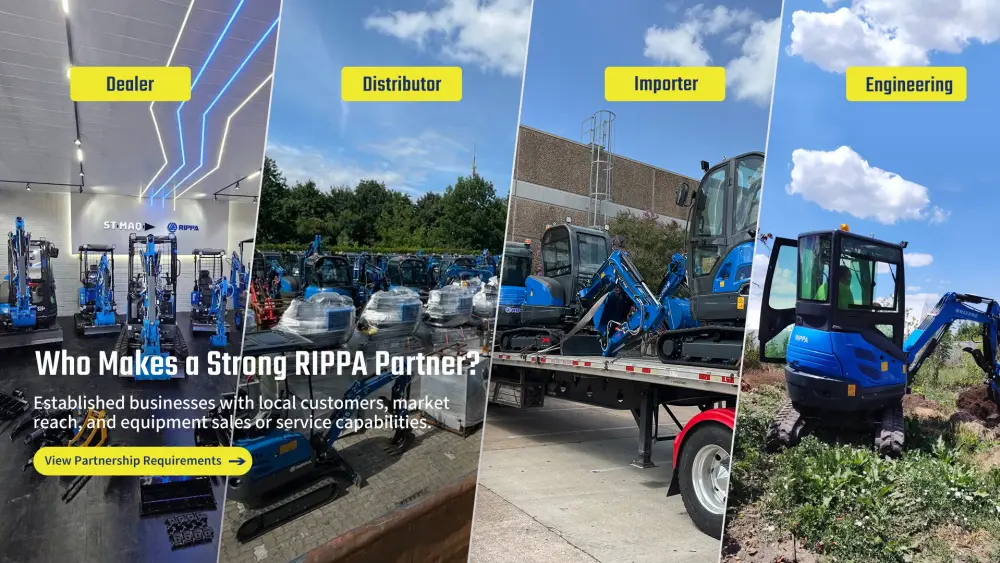
RIPPA’s current dealer information identifies machinery distributors, importers, rental businesses, agricultural equipment sellers, and regional equipment partners as potential compact-excavator partners. Its published dealer program also describes sales and technical training and flexible stocking as parts of its current program.
This means an interested business does not necessarily need to start as a traditional excavator dealership.
However, current:
should be confirmed directly before making an investment decision.
It can be when the business regularly performs drainage, hardscape preparation, planting, excavation, or property-improvement work.
There is no universal number. Compare actual annual rental and subcontracting costs with ownership costs and expected revenue.
Often, yes. Businesses with infrequent excavation needs may benefit from avoiding ownership costs.
Potentially, if local utilization and rental revenue are sufficient to cover ownership and operating costs.
They can be when they support real paid customer work.
Potentially. Contractors, rental companies, existing equipment businesses, and entrepreneurs with relevant customers and resources may eventually expand into equipment sales.
A mini excavator is worth considering when the machine solves a repeated business problem.
The strongest ownership cases usually involve:
For a contractor, it may increase project control.
For a landscaper, it may unlock higher-value services.
For a rental company, it may create another fleet revenue source.
For an established B2B business, it may even become the first step toward compact equipment sales.
The important question is therefore not simply:
“Is a mini excavator worth the money?”
It is:
“Can this machine work often enough—and create enough business value—to justify ownership?”

Autorių teisės: „Shandong Rippa Machinery Group Co., Ltd.“.
Teisinis atstovas: Yan Huaiguo | Licencijos Nr.: 913708000509206491
Adresas: Guangan Road 39, Liuhang mikrorajonas, Aukštųjų technologijų zona, Jiningo miestas, Šandongo provincija

 Pagrindinis puslapis
 Produktai
 El. paštas
 „WhatsApp“