Nov 13, 2026
Inventory planning is one of the most important responsibilities for construction equipment dealers.
Too little inventory may limit sales opportunities and delay customer delivery.
Too much inventory can tie up capital, increase storage costs, and create cash-flow pressure.
For machinery dealers, rental businesses, and equipment distributors, the goal is to maintain a product range that reflects local demand.
This guide explains how to plan inventory across machines, attachments, and replacement parts.
Review your existing sales and customer inquiries.
Identify:
Use actual customer information rather than guessing which products will sell.
A compact equipment dealership may organize inventory into four categories.
| Category | Examples |
|---|---|
| Excavators | Mini and compact excavators |
| Loaders | Skid steer and wheel loaders |
| Attachments | Buckets, grapples and other compatible tools |
| Parts | Filters and commonly required service components |
The appropriate range depends on the dealership’s market and supplier arrangements.
There is no universal inventory quantity for every dealer.
Consider:
Some businesses may begin with a small demonstration inventory.
Larger distributors may choose to maintain multiple models and product categories.

Customers often want to inspect equipment before making a purchasing decision.
A demonstration machine can help dealers:
Use real photographs and videos of available machines to support online marketing.
Attachments can complement equipment sales.
Consider the machines most commonly purchased by your customers and identify compatible attachments.
Important factors include:
Always verify compatibility using official product specifications.
Spare parts support can help dealers provide better service.
Potential inventory categories include:
The exact stock list should be based on machine models, service requirements, and local demand.
Track:
A structured spreadsheet may be sufficient for a small dealership, while larger businesses may need inventory management software.
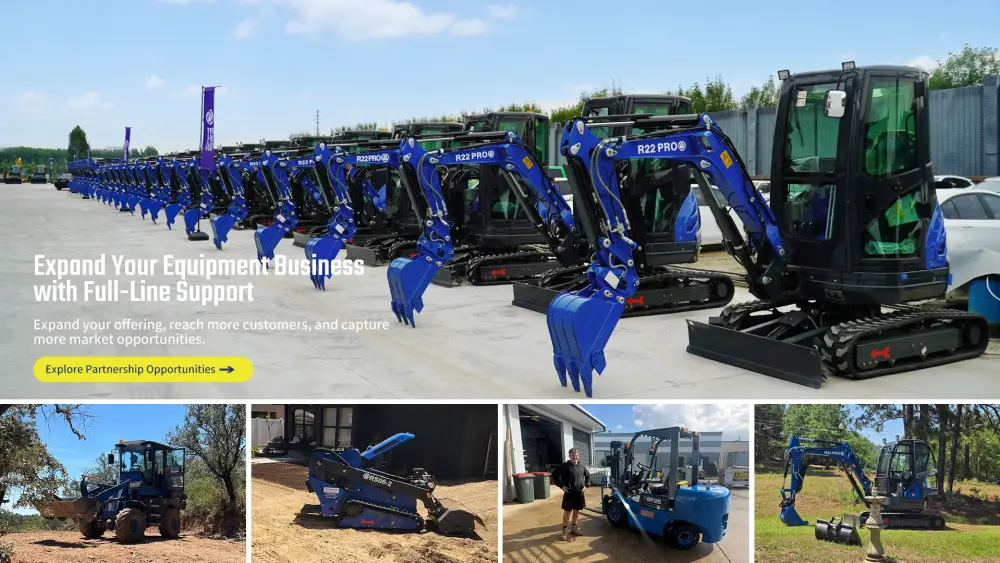
RIPPA’s compact equipment range gives potential dealers several categories to evaluate.
Businesses can discuss available models, product quotations, purchasing arrangements, parts requirements, and market-specific dealer cooperation.
For the U.S. market, internal channel planning has considered 3-, 5-, and 10-unit dealer packages. These are commercial planning proposals, not a universal minimum order requirement for every country or dealer.
Actual purchasing conditions should be confirmed with RIPPA.
No. Start with products that match your customers and expand based on demand.
Attachments may create additional sales opportunities, but compatibility and local demand should guide selection.
It depends on the models sold, service responsibilities, and expected customer requirements.
This may be possible depending on the manufacturer and the agreed dealer arrangement.
Equipment dealer inventory planning requires a balance between customer demand, available capital, storage capacity, and supplier reliability.
A carefully selected product range can help machinery dealers serve customers without committing unnecessary resources to slow-moving inventory.
Build your product range around real customer demand and explore RIPPA’s compact machinery options for your dealership.

Copyright: Shandong Rippa Machinery Group Co., Ltd.
Legal Representative: Yan Huaiguo | License No.: 913708000509206491
Address: No. 39 Guangan Road, Liuhang Subdistrict, High-tech Zone, Jining City, Shandong Province

 Home
 Products
 Email
 WhatsApp