Jan 26, 2026
Choose wheeled skid steers for primarily hard, stable surfaces (concrete, asphalt, packed gravel) where travel speed, lower cost, and easier maintenance are priorities. Choose tracked skid steers (like the RS07 track version) for soft, wet, or delicate terrain (lawns, mud, sand) where superior traction, floatation, and minimal ground damage are critical, accepting a lower travel speed and higher wear-part cost.
My wheeled machine was a champion on my landscaping jobs for municipal contracts. On pavement and hard-packed sites, its 8 km/h top speed meant I could zip from the pile to the truck faster. Wheels are also simpler: no complex undercarriage, cheaper to replace, and generally have lower long-term maintenance costs. If 90% of your work is on surfaces that won’t rut or cause slippage, wheels are the efficient, economical choice. They’re the workhorse for hard ground.
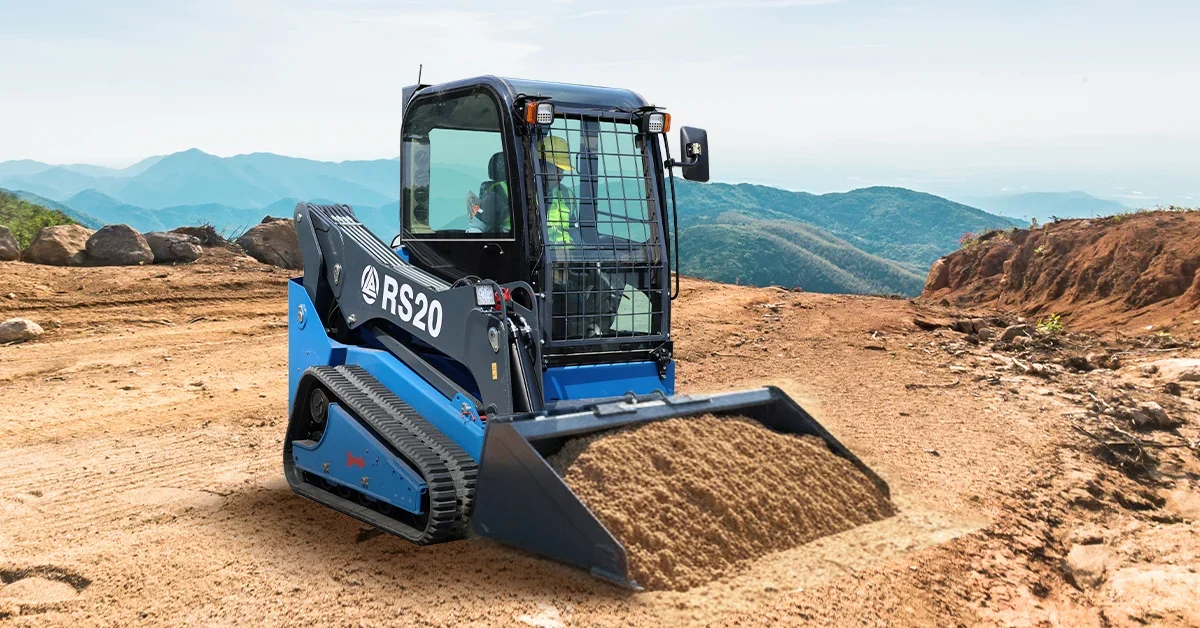
The moment I started doing residential work, wheels became a liability. A 3000-lb machine on tires will leave ruts on a damp lawn. Enter the tracked RS07. The integrated track design spreads its weight over a much larger area, resulting in incredibly low ground pressure. I can now drive across a customer’s prized sod after a rain to deliver mulch with my bucket or use my trencher without leaving a trail of destruction. In mud, the grip is phenomenal. Tracks turn “impossible” days into productive ones.
Most of us face mixed conditions. That’s where understanding the RS07’s specific specs is key. Its tracked version still offers a great travel speed, and its design minimizes vibration. Crucially, with tracks, you gain stability on slopes, which is vital for safety when using attachments like the high-dump bucket. The initial cost is higher, and you must budget for track replacement (a significant wear item). However, for a diverse business, the versatility and site-access tracks provide often justify the investment by allowing you to accept a wider range of jobs.
Your choice between wheels and tracks dictates your market and your schedule. Wheels offer speed and economy on hardscapes. Tracks offer access and preservation on softscapes. Assess your primary revenue-generating surfaces honestly, and let that guide you. The right configuration doesn’t just fit your machine—it fits your business model.

Copyright: Shandong Rippa Machinery Group Co., Ltd.
Legal Representative: Yan Huaiguo | License No.: 913708000509206491
Address: No. 39 Guangan Road, Liuhang Subdistrict, High-tech Zone, Jining City, Shandong Province

 Home
Home
 Products
 Email
Email
 WhatsApp