юни 10, 2026
Telescopic boom loaders like the Rippa RL06 are better for tight spaces because the boom extends and retracts like a crane, allowing the machine to reach forward, upward, and downward without moving. This provides a working radius far exceeding rigid loaders of the same size, enabling the machine to cover a wider, longer, higher, or lower work area without repositioning.
A telescopic boom loader is a wheel loader with a boom that extends and retracts. Unlike a standard loader where the boom only pivots up and down, a telescopic boom has inner and outer sections that slide.
The Rippa RL06 is a telescopic boom loader. The documentation states: The telescopic arm can extend, retract, and lift like a crane, offering a working radius far exceeding that of rigid loaders of the same size. This allows it to cover a wider, longer, higher, or lower work area without the machine having to move.
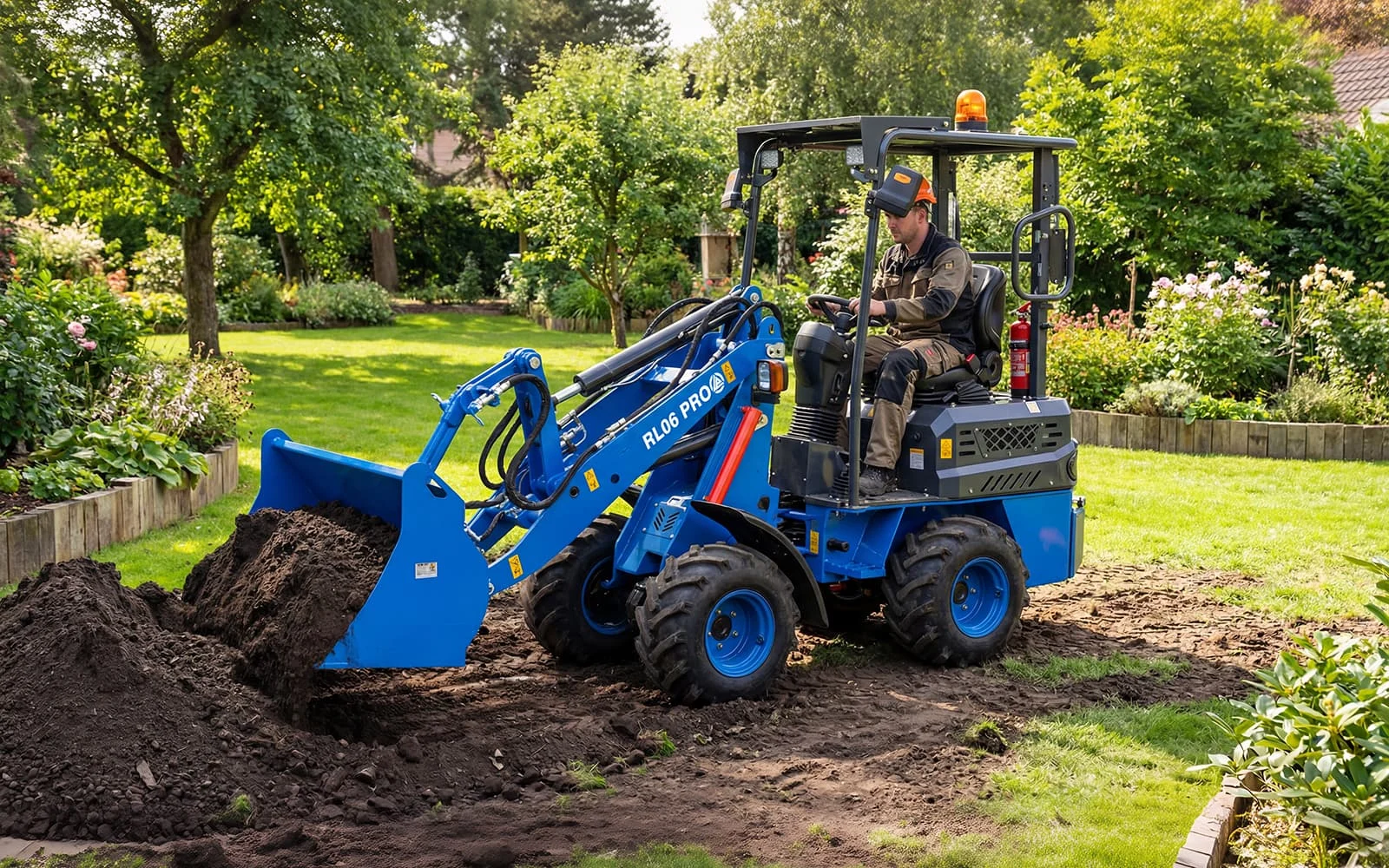 How Telescopic Booms Work
The boom consists of nested sections. A hydraulic cylinder inside the boom pushes the inner sections outward. This extends the boom. Releasing hydraulic pressure allows the sections to retract.
The RL06 can simultaneously:
Raise and lower the boom (vertical movement)
Extend and retract the boom (horizontal movement)
Curl and dump the attachment
This combined movement allows precise placement of material.
In a tight space, you often cannot position the loader directly in front of where you need to place material. A standard loader requires this straight-on approach.
A telescopic boom loader can park in a convenient location and reach around obstacles. For example, you can place the loader at the end of a narrow aisle and extend the boom to reach racks on both sides.
Low ceilings and doorways prevent standard loaders from raising their booms fully. The RL06 with telescopic boom can keep the boom low while reaching forward.
If you need to load material into a second-floor window, a standard loader would need to be directly under the window with the boom fully raised. The RL06 can park further away and extend the boom up and in.
The documentation confirms: Telescopic booms can lift goods to greater heights, for example unloading materials directly into higher truck beds or second-floor slabs, and through the extension and retraction of the boom, the unloading position can be precisely controlled, achieving point-and-place functionality.
The point-and-place functionality mentioned in the documentation is critical in tight spaces. With a standard loader, you inch the machine forward and backward to get the bucket exactly where you want it.
With a telescopic boom, you move the machine to a safe parking position and then use the boom extension for fine positioning. This is faster and safer.
Standard loaders have limited ability to reach below ground level. The bucket pivot point is at axle height. To dig a basement or loading pit, you need to drive the machine into the hole.
A telescopic boom can extend downward. The RL06 can reach into pits, trenches, and basements from ground level.
The documentation specifically mentions this: The telescopic arm can extend, retract, and lift like a crane, offering a working radius far exceeding that of rigid loaders of the same size. This allows it to cover a wider, longer, higher, or lower work area.
In tight spaces, moving the machine is the hardest part. You may need to perform a multi-point turn to reposition a standard loader.
The RL06 stays in one place and uses the telescopic boom to reach the entire work area. Less machine movement means fewer accidents in tight spaces.
| Operation | Standard Loader | RL06 Telescopic Boom |
|---|---|---|
| Reach a high truck tailgate | Drive machine close to truck | Park at safe distance, extend boom |
| Load a second-floor platform | Not possible without ramp | Extend boom up and forward |
| Work in a narrow aisle | Machine must fit in aisle | Machine parks at end, boom reaches in |
| Pick material from a pit | Drive machine into pit | Park at edge, extend boom down |
| Place material precisely | Inch machine forward and back | Use boom extension for fine control |
| Change attachments | Requires exiting cab for some models | Use quick coupler from cab |
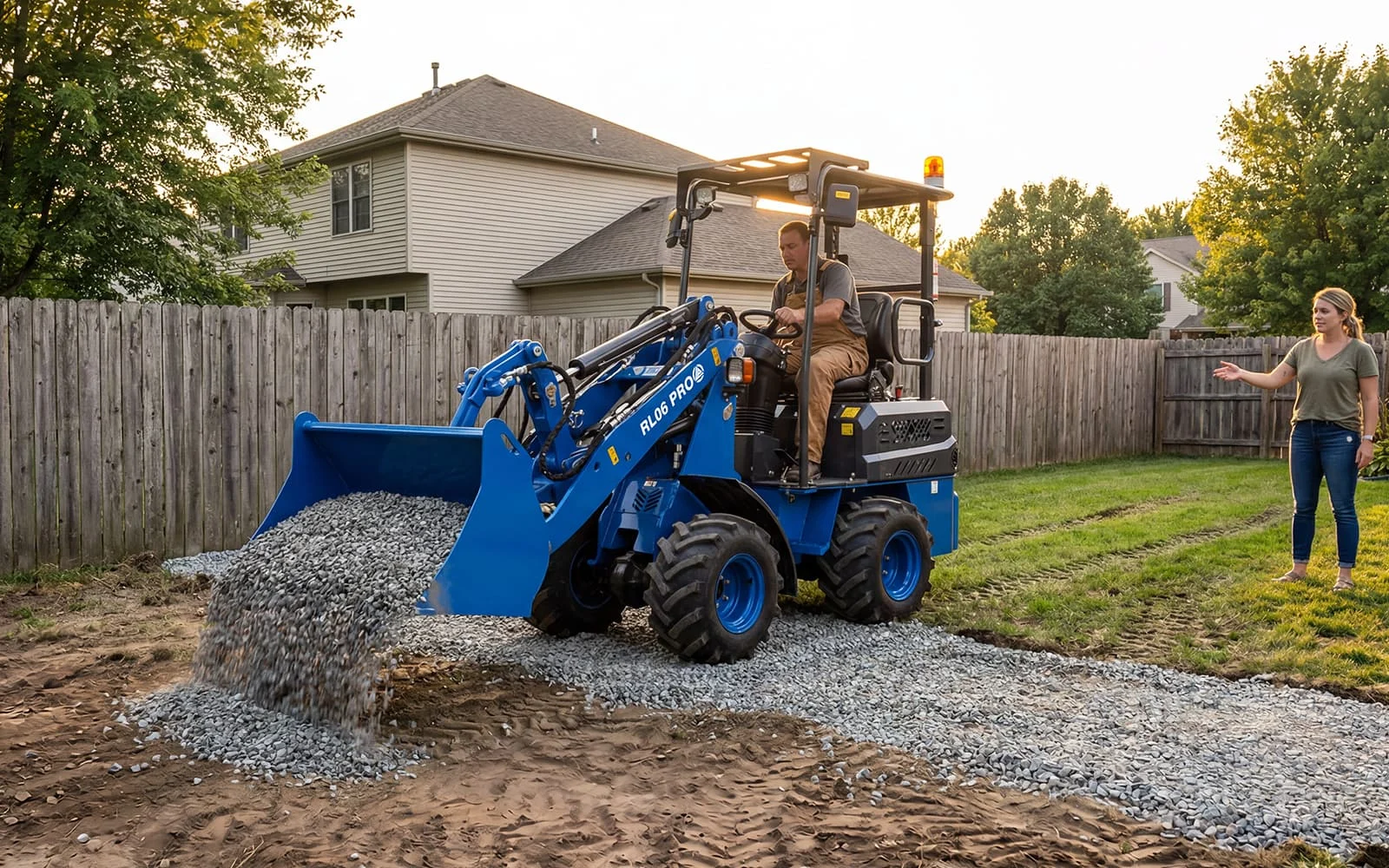
The RL06 with telescopic boom and pallet forks can reach into high racking from the aisle. The machine parks at the end of the aisle or in a wide spot, then extends the boom to reach pallets. This is particularly useful for:
Reaching pallets on mezzanine levels
Loading trucks at dock height
Placing items on top of storage racks
Contractors use the RL06 to place materials exactly where needed:
Lifting bricks and mortar to second-floor scaffolding
Placing roofing materials onto roofs
Reaching across excavations to place material on the far side
The documentation states that through the extension and retraction of the boom, the unloading position can be precisely controlled, achieving point-and-place functionality.
Farm applications benefit from the reach of a telescopic boom:
Loading feed into troughs from a distance
Stacking hay bales in tall barns
Reaching over fences to place materials
Cleaning manure from pits without entering the pit
Recycling facilities use the RL06 for:
Picking material from tall sorting lines
Reaching into roll-off containers
Feeding hoppers that are set back from the operating area
When clearing snow around buildings, the RL06 can:
Reach between parked cars without moving
Place snow over high snow banks
Work around light poles and signs without repositioning
The RL06 telescopic boom loader includes a quick-change connector system. This is critical for tight spaces because it allows you to change attachments from the cab.
The documentation states: Telescopic boom loaders all use a quick connector system, allowing the operator to quickly change dozens of different attachments such as buckets, forks, sweepers, hydraulic hammers, aerial work platforms, and more from the cab.
In a tight space, you cannot exit the cab to change attachments manually. The ground may be muddy. There may be no room to lay down tools. The cab-controlled quick-change system solves this problem.
Every design has trade-offs. Understand these before purchasing.
Like a crane, a telescopic boom has reduced capacity when fully extended. The RL06 rated capacity is for the bucket close to the machine. At full extension, reduce the load.
Telescopic mechanisms are more expensive to manufacture. The RL06 costs more than a standard loader of similar size.
The telescopic sections require regular greasing and inspection. Slider pads wear and need replacement.
Extending and retracting the boom takes time. For repetitive loading of a nearby truck, a standard loader is faster.
Choose the RL06 telescopic boom loader if:
You need to reach over, under, or around obstacles. Standard loaders cannot do this at all.
Your work area has height restrictions such as low doorways or ceilings. The telescopic boom keeps the machine low while reaching high.
You need precise placement of materials. The point-and-place functionality is unique to telescopic booms.
You have multiple attachments and need to change them frequently. The cab-controlled quick coupler makes this practical.
You work in tight spaces where moving the machine is difficult. Less machine movement means faster and safer work.
Choose a standard loader like the RL10, RL15, or RL20 if:
You do simple load-and-carry work. You drive to a pile, load, drive to a truck, and dump.
You need maximum lift capacity for the price. Standard loaders put more of the machine weight into lift capacity rather than telescopic mechanism.
You never need to reach over obstacles.
You have wide open spaces with no tight constraints.
Question 1: Can the RL06 lift as much as a standard loader of the same size?
Answer: At full retraction, it is similar. At full extension, lift capacity is reduced. Check the load chart for your specific configuration.
Question 2: How far can the RL06 reach?
Answer: The documentation does not specify exact reach dimensions. Contact your dealer for precise specifications.
Question 3: Is the telescopic boom difficult to maintain?
Answer: The mechanism requires regular greasing. The slider pads wear and need periodic replacement. However, Rippa designed the RL06 for easy maintenance with seat access to engine components and a neat internal layout.
Question 4: Can I put any attachment on the telescopic boom?
Answer: The RL06 uses a universal quick-coupler system. It accepts buckets, forks, sweepers, hammers, augers, aerial platforms, and most standard skid-steer attachments.
Question 5: Is the RL06 stable when the boom is fully extended?
Answer: Yes, when operated within its rated capacity. Always keep the load as low as practical. Extend the boom with the load low, then raise after extending.


 Начало
 Продукти
 Имейл
Имейл
 WhatsApp